
Threat Intel
Copy‑On‑Write Chaos: Detecting the 2026 Linux Privilege Escalation Surge
In 2026 a wave of Linux privilege‑escalation CVEs exploded from a single copy‑on‑write bug, hitting kernel interfaces from networking to filesystems. RootPwn’s briefing explains how the same exploit pattern surfaces across diverse subsystems, how Elastic Defend and Auditd can surface the common escalation flow, and what rules to deploy to catch both the generic root‑gain pattern and the specific COW‑related techniques.
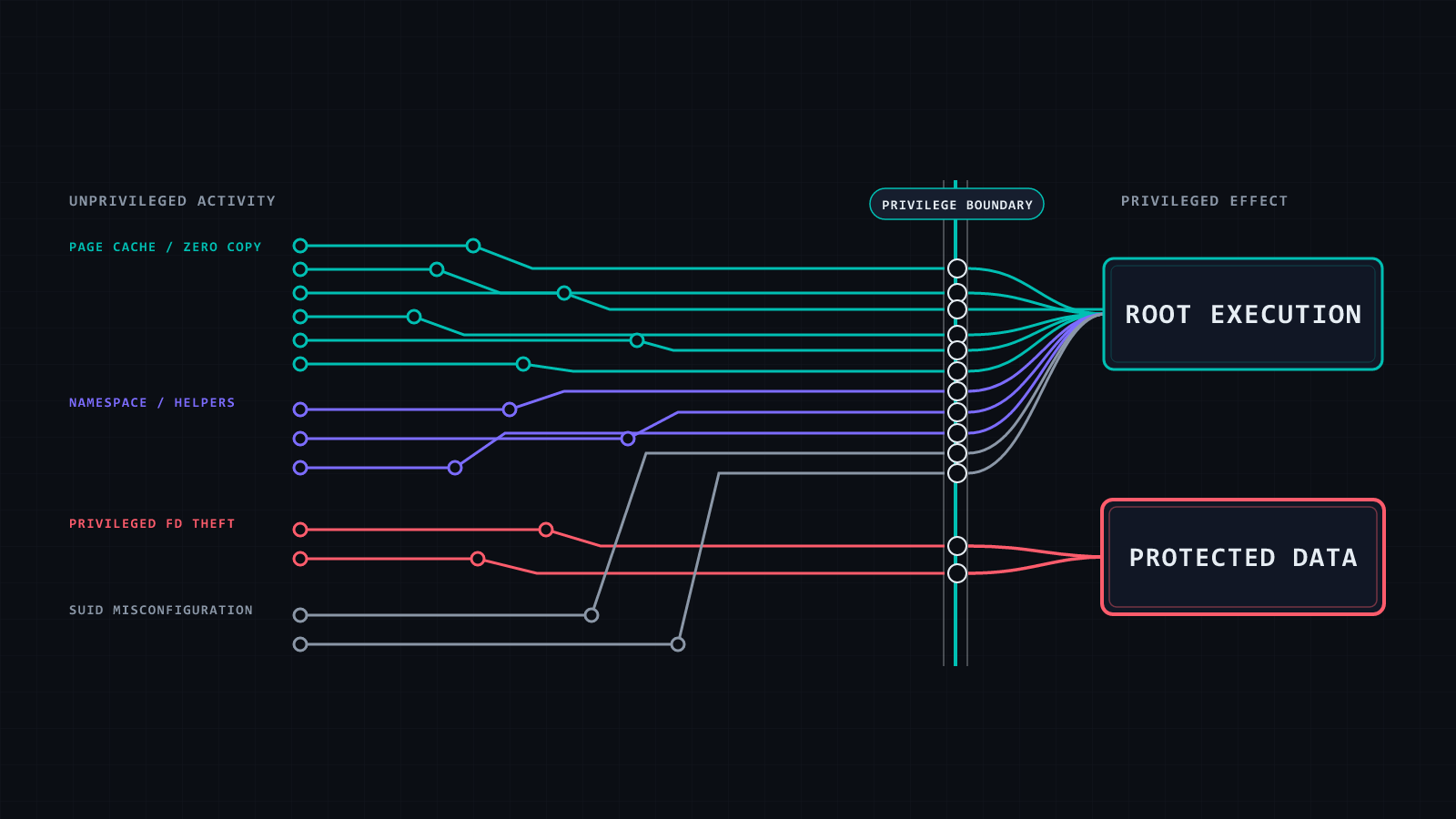
Linux has long been a playground for privilege‑escalation (LPE) attacks. Until 2026, each new CVE seemed to come from a different corner of the kernel: sudo, pkexec, eBPF, ptrace, user namespaces, and so on. That diversity kept detection manageable – a rule for each unique subsystem, a rule for each new advisory.
2026: One Bug, Many Interfaces
Seven of the thirteen LPE CVEs tracked this year all stem from the same copy‑on‑write (COW) race condition. The flaw lets an attacker write to memory that should have been copied, corrupting data paths across a dozen kernel modules. The bugs appeared in:
- ESP, RxRPC, and socket‑buffer helpers (DirtyFrag, Fragnesia, DirtyDecrypt, DirtyClone)
- Traffic control (pedit COW)
- Filesystem (RefluXFS)
- Other kernel interfaces (Copy Fail)
Research teams used large‑language models to hunt for new COW instances, feeding known patterns into Claude or similar tools and iterating until a fresh vulnerability surfaced. The result was a rapid, concentrated release cycle that overwhelmed traditional per‑CVE rule creation.
Detection Strategy: Two Layers
Despite the variety of affected subsystems, every LPE follows the same high‑level flow: an unprivileged process gains root privileges. Elastic Defend leverages this by:
- Generic Flow Rule – monitors for a non‑root process spawning a root process or a sudden privilege jump.
- Technique‑Specific Layer – adds signatures for the COW bug class (e.g., specific syscalls, memory patterns, or auditd events).
Because the underlying trigger is the same, a single set of detection rules can flag the majority of these exploits. The technique layer simply tightens the net for known COW vectors.
Setting Up Detection with Elastic Defend and Auditd
"Enable the prebuilt rules, deploy Elastic Defend on a test host, and add Auditd integration for syscall visibility."
Follow these steps to reproduce the telemetry in a lab environment:
- In Kibana, go to
Security > Rules > Detection rules (SIEM)and install the Elastic prebuilt rules. - Filter by tags
OS: LinuxandTactic: Privilege Escalationto enable the relevant rules. - Deploy Elastic Defend on a Linux VM to capture endpoint behavior.
- Enable the Auditd Manager integration; the page‑cache class relies on
socket,splice,bind, andexecveaudit events. - For the COW‑specific rules, add the auditd entries listed in the Copy Fail and DirtyFrag research notes.
- Run the publicly released proof‑of‑concepts in a disposable VM. Treat all exploit code as lab‑only; never run it against systems you don’t own.
All detection rules are available in the Elastic detection‑rules repository, while endpoint rules can be found in the Elastic Defend rule set.
Bottom Line
The 2026 LPE wave demonstrates that a single kernel flaw can proliferate across many interfaces, but the resulting privilege escalation still follows a predictable pattern. By layering a generic root‑gain rule with a focused COW signature, defenders can stay ahead of the rapid release cycle and reduce the noise of per‑CVE rule churn.
Related vulnerabilities

Linux Kernel 'Copy Fail' (CVE‑2026‑31431) Hits All Mainstream Distros – Immediate Action Needed
A high‑local privilege escalation flaw dubbed "Copy Fail" (CVE‑2026‑31431) now affects every mainstream Linux distribution using a kernel built since 2017. A public proof‑of‑concept exists, but no vendor patches have been released yet. The mainline kernel fix landed on April 1, 2026, yet distribution updates lag behind. CERT‑EU urges users to deploy the interim mitigation right away, especially on Kubernetes nodes and CI/CD runners exposed to untrusted workloads.
Read briefing
Ivanti Connect Secure & Policy Secure Gateways Hit by Multi‑Vulnerability Surge – Patch Now
A wave of critical flaws—CVE‑2024‑22024, CVE‑2024‑21888, CVE‑2024‑21893, CVE‑2023‑46805, CVE‑2024‑21887—has been actively exploited against Ivanti Connect Secure and Policy Secure Gateways. The bugs enable unauthenticated privilege escalation, SSRF, and remote code execution, letting attackers hijack devices and steal credentials. Ivanti released patches for most affected versions in February, with additional fixes rolled out through March. Immediate patching, re‑authentication, and hardened configuration are essential to stop attackers from leveraging these weaknesses.
Read briefing
HPE Aruba SD‑WAN Products Hit by Multiple Remote Code Execution and Privilege‑Escalation Flaws
HPE Aruba Networking has disclosed a set of critical flaws in its EdgeConnect SD‑WAN Gateways and Orchestrator that can be exploited for remote code execution, privilege escalation, and denial‑of‑service. Affected releases include Gateway 9.4.x‑9.7.x (pre‑9.4.9.0, 9.5.9.0, 9.6.4.0, 9.7.1.0) and Orchestrator 9.4.x‑9.7.x (pre‑9.4.11, 9.5.9, 9.6.4, 9.7.1.0). The CVE list ranges from CVE‑2024‑32664 to CVE‑2026‑76696. Patch the firmware immediately and follow HPE’s advisory for configuration hardening.
Read briefing
ClamAV Vulnerabilities Enable Remote DoS on Cisco Secure Endpoint Connectors
A bundle of seven CVEs (CVE‑2026‑20337 through CVE‑2026‑20348) in ClamAV lets attackers trigger a denial‑of‑service on Cisco Secure Endpoint Connector software. The flaw is most critical on Windows, where the scanner runs with elevated privileges, but still poses a medium risk on Linux and macOS. Cisco has pushed patches for all affected platforms; no work‑arounds exist. The Private Cloud service itself remains unaffected, though its on‑device connector is vulnerable.
Read briefing