
Vulnerabilities
CVE-2026-0307: Palo Alto Networks GlobalProtect App Local Privilege Escalation
Palo Alto Networks has disclosed a medium-severity local privilege escalation vulnerability affecting the GlobalProtect app across Windows, macOS, and Linux. Low-privileged users can exploit this flaw to execute arbitrary commands with highest-level system privileges. Sysadmins must review patch availability and update client installations according to the vendor timeline.

What Happened
Palo Alto Networks published an advisory for CVE-2026-0307, a medium-severity local privilege escalation vulnerability residing in the GlobalProtect client application. Triggered via an untrusted search path weakness (CWE-426), the flaw enables a standard, non-administrative local user to elevate their execution context to NT AUTHORITY\SYSTEM on Windows hosts, and root privileges on macOS and Linux systems.
Impacted Systems and Scope
The vulnerability affects desktop and workstation operating systems running specific versions of the GlobalProtect app:
- GlobalProtect App 6.3: Versions up to 6.3.3-h14 (Linux, macOS, Windows)
- GlobalProtect App 6.2: Versions up to 6.2.8-h14 (macOS, Windows)
- GlobalProtect App 6.0: Versions up to 6.0.14 (Linux, macOS, Windows)
Mobile platforms, including iOS, Android, and ChromeOS, are entirely unaffected. No special configurations are required to trigger the exposure, and the attack vector is strictly local, requiring low privileges with no user interaction.
Defense and Mitigation Actions
Defenders and sysadmins should prepare to deploy patched versions of the GlobalProtect client as they become generally available through scheduled vendor releases:
- Upgrade GlobalProtect App 6.3 on Linux to version 6.3.3-h15 or later.
- Monitor vendor release schedules for Windows and macOS builds (targeted rollout through September and October).
- Ensure corresponding PAN-OS infrastructure and Prisma Access tenants are updated alongside client deployments where required.
Note that exploitation maturity is currently reported as untreported, and Palo Alto Networks is unaware of any active in-the-wild exploitation targeting this advisory.
Related vulnerabilities
Critical PAN-OS Buffer Overflow (CVE‑2026‑0300) Enables Root‑Level Code Execution
Palo Alto Networks has disclosed a 9.3‑scored buffer overflow in the User‑ID Authentication Portal of PAN‑OS that lets an unauthenticated attacker run arbitrary code with root privileges on PA‑Series and VM‑Series firewalls. Affected firmware spans versions before 12.1.4‑h5, 12.1.7, 11.2.4‑h17, and several earlier releases. No patch is live yet, but Palo Alto will ship one soon. Until then, limit or disable the captive portal. Immediate update is urged to shut the door on this critical flaw.
Read briefing
Linux Kernel 'Copy Fail' (CVE‑2026‑31431) Hits All Mainstream Distros – Immediate Action Needed
A high‑local privilege escalation flaw dubbed "Copy Fail" (CVE‑2026‑31431) now affects every mainstream Linux distribution using a kernel built since 2017. A public proof‑of‑concept exists, but no vendor patches have been released yet. The mainline kernel fix landed on April 1, 2026, yet distribution updates lag behind. CERT‑EU urges users to deploy the interim mitigation right away, especially on Kubernetes nodes and CI/CD runners exposed to untrusted workloads.
Read briefing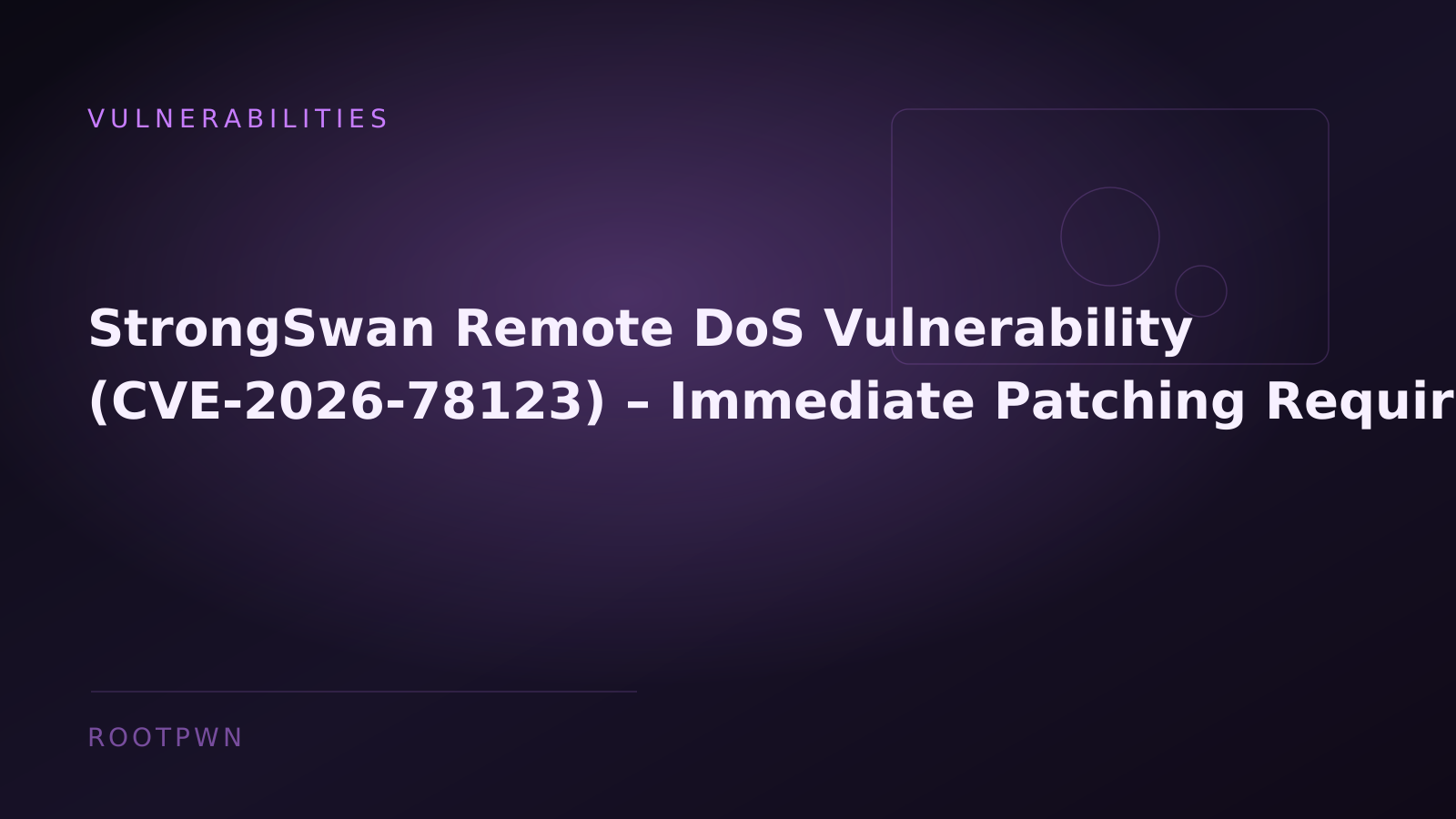
StrongSwan Remote DoS Vulnerability (CVE‑2026‑78123) – Immediate Patching Required
A critical remote denial‑of‑service flaw has been discovered in StrongSwan VPN software, identified as CVE‑2026‑78123. The vulnerability allows attackers to crash the daemon on any system running a version older than 6.1.0, potentially taking networks offline. It is triggered by malformed IKE packets and can be mitigated by applying the vendor‑released patch. All affected deployments should update immediately.
Read briefing
Wärtsilä FOS‑Onboard Faces Dual Hard‑Coded Key Vulnerabilities (CVE‑2026‑78225, CVE‑2026‑81855)
Two critical CVEs expose hard‑coded cryptographic keys in Wärtsilä FOS‑Onboard 5.07.0923.01, allowing attackers to push unauthorized updates, execute code or steal credentials. With a CVSS score of 9.1, the flaws threaten transportation‑system operators worldwide. Wärtsilä has released a patch; users must contact the vendor to apply it immediately.
Read briefing