
Threat Intel
Google Warns LLMjacking Attacks Inflate Enterprise Cloud Bills to $1 Million
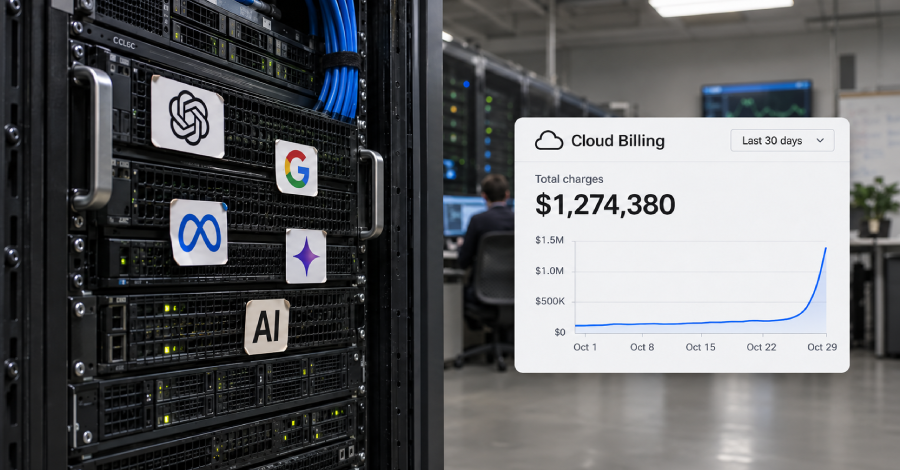
Google has identified a new threat called LLMjacking, where attackers hijack enterprise LLM API keys to generate fraudulent cloud usage that can reach $1 million in a single organization. The attacks exploit exposed credentials and misconfigured secrets, causing rapid bill spikes. Defenders should audit keys, enforce rotation, and monitor usage to mitigate the risk.
What Happened
Google announced on Monday that a new form of resource hijacking, dubbed LLMjacking, is inflating cloud bills for enterprises that use large language models. Attackers are exploiting compromised API keys to send requests to LLM services, causing the legitimate account owner to pay for the compute time. The technique is similar to cryptojacking but produces billable activity in seconds rather than minutes.
In the incidents reported, attackers leveraged phishing, code leaks, misconfigured IAM credentials, and exposed client‑side code to obtain valid keys. Once in possession of a key, they can invoke the model as often as they wish, generating hundreds of thousands of dollars in usage before the key is revoked.
Who Is Affected
The attacks have been observed across North America, South America, and the Asia‑Pacific region. Sectors hit include financial services, retail, technology, and transportation. Any organization that relies on paid LLM APIs—whether through Google Cloud, AWS Bedrock, or Azure OpenAI—faces risk if its credentials are not properly secured.
Both large enterprises and mid‑market companies have reported incidents, indicating that the threat is not limited to high‑profile targets. The common denominator is the presence of exposed or weakly protected API keys.
Impact
Google’s threat intelligence group measured fraudulent usage spikes of more than $100,000 in a single day in several cases. In the most extreme example, cumulative charges exceeded $1 million before the offending key was disabled. These amounts represent a direct financial loss that is difficult to recover.
Beyond the bill, the attacks can also consume quota limits, delay legitimate requests, and create a false sense of normal activity that may mask other malicious behavior.
Exposure
Initial access is typically achieved through exposed cloud identity tokens such as IAM service account keys, GitHub personal access tokens, or active session cookies. Attackers then use these tokens to call the LLM endpoint or to retrieve the API key from a misconfigured secrets store.
In one documented case, a misconfigured service account key allowed an adversary to retrieve the key for a Google Cloud LLM API. The attacker subsequently spun up a bot that sent thousands of prompts, each of which consumed compute credits.
What to Do
Defenders should immediately audit all LLM API keys and enforce the principle of least privilege. Keys that are not in active use should be rotated or deleted. The following actions are recommended:
- Enable IAM key rotation and enforce short lifetimes for service account keys.
- Use secret management services (e.g., Google Secret Manager, AWS Secrets Manager) and restrict access to the secrets store.
- Implement API gateway throttling and request quotas for LLM endpoints.
- Enable logging for all LLM API calls and set up alerts for anomalous usage patterns.
- Apply network segmentation so that only trusted services can reach the LLM endpoint.
- Educate developers on secure handling of client‑side code and on the risks of embedding keys in front‑end assets.
- Conduct regular penetration tests that include credential discovery and LLM usage simulation.
What to Watch
Attackers are evolving their techniques. Future vectors may involve automated credential harvesting from CI/CD pipelines or exploitation of zero‑day misconfigurations in new AI services. Keep an eye on emerging threat groups such as UNC6993, which have demonstrated the ability to pivot from a compromised service account to LLM exploitation.
Also monitor for signs of “chatbot hijacking,” where attackers manipulate customer‑facing chatbots to generate unauthorized requests. Such activity can be subtle and may not trigger traditional alerts.
Related articles
CrowdStrike Expands Falcon Adversary OverWatch to Cover AI Workloads and Google Cloud
CrowdStrike has broadened its Falcon Adversary OverWatch service to include 24/7 managed threat hunting for AI applications and deeper telemetry for Google Cloud environments. The update gives defenders continuous visibility into AI‑driven attacks and cloud‑specific vectors, enabling proactive detection and response.
Read briefing
CrowdStrike Expands Falcon Adversary OverWatch to Cover AI Workloads and Google Cloud Threat Hunting
CrowdStrike has extended its Falcon Adversary OverWatch managed threat hunting service to include 24/7 coverage of AI applications and autonomous agents, as well as enhanced telemetry‑driven hunting for Google Cloud environments. The update provides defenders with deeper visibility into AI‑driven attacks and cloud‑native threats, enabling faster detection and response. Security teams should enable the new features, review agent telemetry, and adjust monitoring policies accordingly.
Read briefing
Defending Against Cross-Environment Pivots in Modern Enterprise Security Operations
Recent threat intelligence highlights a significant operational challenge for SecOps teams: adversaries are routinely pivoting across multiple enterprise environments to evade detection. According to recent incident response data, nearly half of all attacks span four or more attack surfaces, exploiting visibility gaps in siloed security tooling. Defenders must unify telemetry across cloud, endpoint, network, identity, and SaaS domains to successfully reconstruct complex attack paths.
Read briefing
CrowdStrike Expands OverWatch Threat Hunting to AI Agents and Google Cloud Workloads
CrowdStrike has extended Falcon Adversary OverWatch to cover AI application telemetry and Google Cloud infrastructure. This expansion provides 24/7 managed hunting for autonomous agent behavior and deeper visibility into GCP environments. Defenders should review their coverage gaps regarding AI-driven attack surfaces and cloud-specific telemetry.
Read briefing