
Vulnerabilities
Grid Protection Alliance openPDC & openHistorian Vulnerabilities: CVE-2026-100730 and Related Issues
Grid Protection Alliance’s openPDC and openHistorian contain multiple critical flaws, including deserialization of untrusted data, missing authentication, SSRF, hard‑coded credentials, and unsafe reflection. Versions below 2.9.482 (openPDC) and 2.8.585 (openHistorian) are affected. Administrators should update to the latest releases and review authentication settings.

What happened
Grid Protection Alliance released several critical flaws in its openPDC and openHistorian products. The issues include deserialization of untrusted data, missing authentication for critical functions, server‑side request forgery, hard‑coded credentials, and unsafe reflection. The vulnerabilities are identified as CVE‑2026‑100730, CVE‑2026‑104629, CVE‑2026‑105281, CVE‑2026‑85479, CVE‑2026‑101022, and CVE‑2026‑105278.
Impact
Severity: CVSS v3 9.8 (critical)
- Versions <2.9.482 of openPDC and <2.8.585 of openHistorian are affected.
- Unauthenticated network attackers can trigger remote code execution on systems without Windows Authentication.
- Authenticated attackers can exploit the service console to execute arbitrary code under the service account.
What to do
- Upgrade openPDC to 2.9.482 or later and openHistorian to 2.8.585 or later.
- Verify that Windows Authentication is enabled or restrict network access to the service console.
- Remove or change any hard‑coded credentials and review configuration files for exposed secrets.
- Apply any vendor‑issued patches that add input validation to serialization logic.
Remediation status
Grid Protection Alliance has released fixes that add validation to serialization logic and address the other listed vulnerabilities. Deploy the latest versions as soon as possible.
Related vulnerabilities

SAP Exposes Critical Kernel & Message Server Flaws: CVE-2026-44756 & CVE-2026-58240
SAP’s September Security Patch Day revealed two critical vulnerabilities that can be exploited remotely without authentication. The memory‑corruption flaw in SAP Extended Passport (OVERPASS, CVE‑2026‑44756) and the missing‑auth bug in NetWeaver Message Server (S4GET, CVE‑2026‑58240) both allow attackers to run arbitrary OS commands as the SAP installation user, risking full system takeover. Immediate application of SAP Security Notes 3747649 and 3759472 is mandatory.
Read briefing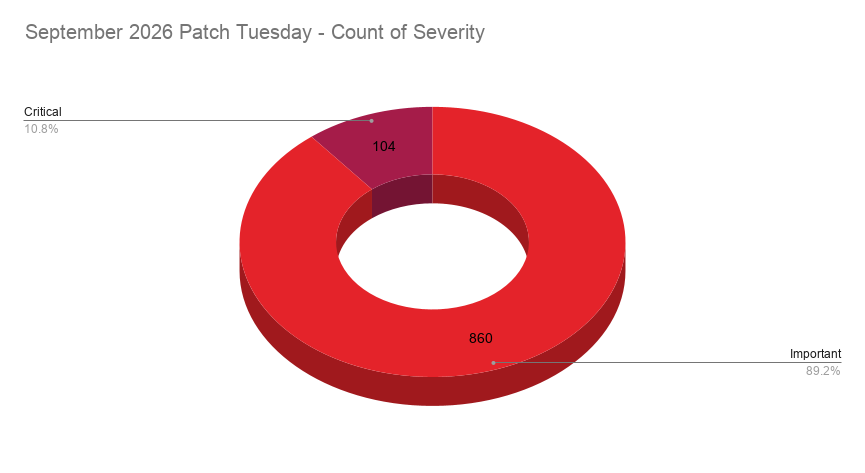
Microsoft September 2026 Patch Tuesday: 964 CVEs, Including Two Zero-Day Exploits (CVE-2026-81963, CVE-2026-85880)
Microsoft released its largest Patch Tuesday to date, addressing 964 CVEs—104 critical and 860 important—including two zero‑day vulnerabilities exploited in the wild. Defenders must prioritize applying updates to affected components such as .NET, Active Directory services, Azure services, Office, and Windows kernel drivers, and verify system integrity.
Read briefing
Microsoft Edge Addresses CVE-2026-95332: Uninitialized Variable in Tint
A recent CVE (CVE‑2026‑95332) in Chromium’s Tint component could allow memory corruption via an uninitialized variable. Microsoft Edge (Chromium‑based) has incorporated the fix. Defenders should verify that Edge is updated to the latest release and monitor for related alerts.
Read briefing
OpenSSL and WolfSSL Patch High‑Severity DTLS Vulnerabilities (CVE‑2026‑84782, CVE‑2026‑84783)
OpenSSL and WolfSSL released updates fixing a dozen critical bugs, including CVE‑2026‑84782 that lets unauthenticated attackers leak heap fragments or crash DTLS sessions. The flaw can be triggered during a DTLS handshake and is exploitable over the network without credentials. Defenders should upgrade to the latest releases and verify DTLS configurations.
Read briefing