
Advisories
Microsoft September 2026 Patch Tuesday: 964 CVEs, Including Two Zero-Day Exploits (CVE-2026-81963, CVE-2026-85880)
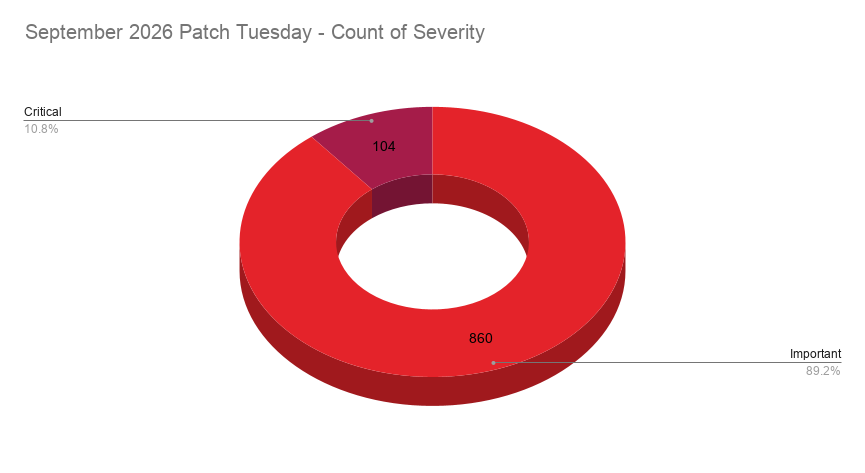
Microsoft released its largest Patch Tuesday to date, addressing 964 CVEs—104 critical and 860 important—including two zero‑day vulnerabilities exploited in the wild. Defenders must prioritize applying updates to affected components such as .NET, Active Directory services, Azure services, Office, and Windows kernel drivers, and verify system integrity.
What Happened
On 2026‑09‑12 Microsoft issued a Patch Tuesday update that fixed 964 CVEs, the most ever in a single release. The update includes patches for two zero‑day vulnerabilities (CVE‑2026‑81963 and CVE‑2026‑85880) that were actively exploited in the wild.
Impact
All Windows, Office, Azure, and related Microsoft products are affected. The critical and important CVEs span user‑mode applications, kernel drivers, and cloud services, potentially allowing remote code execution, privilege escalation, or data exfiltration.
Affected Products
- .NET Framework and .NET Core
- ASP.NET Core
- Active Directory Domain Services, AD CS, AD FS
- Azure services: Azure Arc, Azure HDInsights, Azure CycleCloud, Azure Attestation, Azure CLI, Azure SDKs
- Microsoft Office suite (Word, Excel, PowerPoint, Outlook, Access, Publisher, SharePoint)
- Microsoft Teams, Visual Studio, Visual Studio Code, GitHub Copilot
- Windows kernel components: HID class driver, IP Helper, Kernel Streaming, WOW Thunk, UxTheme, WDAC, SCSI Class, Windows Search, Windows Media Foundation, Windows PDF, Windows Speech, OpenSSH
- Microsoft Account, Microsoft Authenticator, Microsoft Dynamics 365, Microsoft Exchange Server, Microsoft Graph, Microsoft Install Service, Microsoft JScript, Microsoft Local Security Authority (lsasrv)
- Other components: Connected Devices Platform Service, Data Sharing Service, Client GitHub Copilot, Microsoft Graphics Component, Microsoft WebP Image Extension, Microsoft Windows Codecs Library, Microsoft Windows Media Foundation, Microsoft Windows PDF, Microsoft Windows SCSI Class System File, Microsoft Windows Search Component, Microsoft Windows Speech OpenSSH, Microsoft Trace Data Helper, Microsoft UxTheme Library (uxtheme.dll)
Mitigation Steps
- Run Windows Update or download the cumulative update package for your operating system and architecture.
- Apply updates to all affected Microsoft products, including Office, Azure services, and third‑party applications that depend on Microsoft libraries.
- Verify that the patch was installed by checking the update history and the CVE identifiers in the registry or update logs.
- Reboot systems where required; some kernel driver updates need a full restart.
- Implement monitoring for anomalous authentication or privilege‑escalation attempts, especially around AD and Azure services.
- Consider hardening measures such as disabling legacy protocols, enforcing MFA, and enabling Windows Defender Application Guard for untrusted content.
- Maintain a baseline of known vulnerable components and regularly audit for missing patches.
Related vulnerabilities
Microsoft Unleashes 972 CVE Fixes on Patch Tuesday, Including 2 Exploited Zero‑Days and 113 Critical Flaws
Microsoft’s September 2026 Patch Tuesday update tackles 972 CVEs—two of which are actively exploited zero‑days and 113 critical vulnerabilities. The patch covers Windows, Office, and other Microsoft components, tightening defenses across the ecosystem. Security teams should apply the fixes immediately and monitor for any lingering exploitation attempts.
Read briefing
SAP Exposes Critical Kernel & Message Server Flaws: CVE-2026-44756 & CVE-2026-58240
SAP’s September Security Patch Day revealed two critical vulnerabilities that can be exploited remotely without authentication. The memory‑corruption flaw in SAP Extended Passport (OVERPASS, CVE‑2026‑44756) and the missing‑auth bug in NetWeaver Message Server (S4GET, CVE‑2026‑58240) both allow attackers to run arbitrary OS commands as the SAP installation user, risking full system takeover. Immediate application of SAP Security Notes 3747649 and 3759472 is mandatory.
Read briefing
CVE‑2026‑108455: PowerPoint Information Disclosure – Update Omission Clarified
Microsoft Office PowerPoint’s information disclosure vulnerability (CVE‑2026‑108455) was fixed in the October 2026 security update, but the CVE was omitted from the advisory list. Defenders should verify the update is installed; no further action is required if already updated.
Read briefing
Critical Cisco Hardening Release: ASA, FTD, FMC Patch Internal Exploits
Cisco’s security team has rolled out a hardening update for its Secure Firewall Adaptive Security Appliance, Threat Defense, and Management Center software, addressing a suite of internally discovered flaws. Eight CVEs (CVE‑2026‑20329 through CVE‑2026‑20336) cover issues ranging from static credential exposure to authentication bypass, with two vulnerabilities already being actively exploited. No workarounds exist; customers must install the patches promptly to mitigate the critical risk.
Read briefing