
Vulnerabilities
Linux Rootkits: Hooking Evolution and Defensive Implications
Linux rootkits have moved from simple user‑space hijacking to sophisticated eBPF and io_uring hooks that embed malicious logic directly into the kernel. Attackers use these techniques to evade detection and maintain persistence. Defenders should monitor kernel integrity, audit eBPF programs, and validate system call tables to spot anomalous hooks.
What Happened
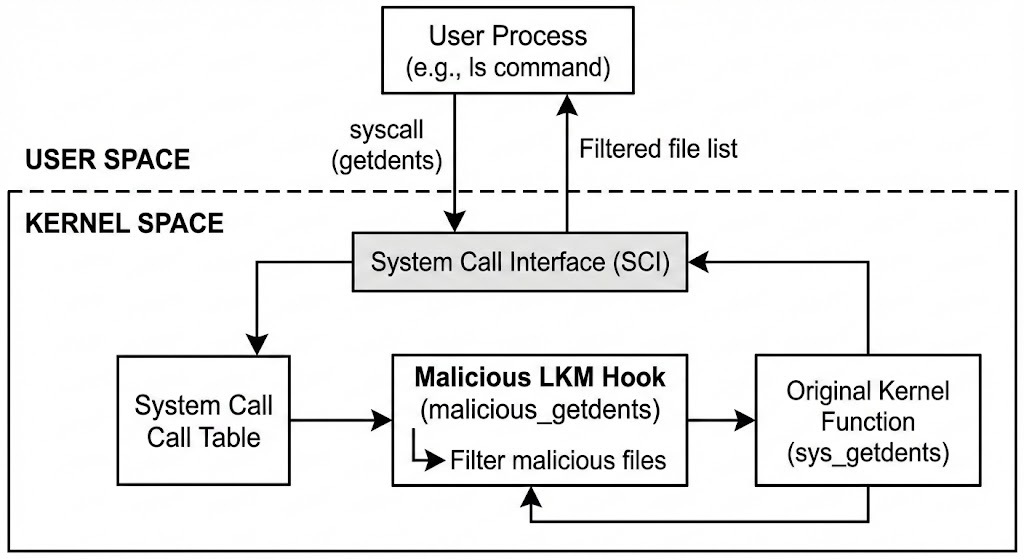
Recent analyses show a shift in Linux rootkit design toward kernel‑level hooking via eBPF and io_uring, replacing older shared‑object hijacking methods. These new techniques allow attackers to embed malicious logic directly into the kernel without loading traditional loadable kernel modules.
Rootkit Taxonomy
Rootkits can be classified by execution context: user‑space, kernel‑space, and hybrid. User‑space rootkits modify library loading (LD_PRELOAD) or replace shared objects. Kernel‑space rootkits alter kernel data structures, intercept system calls, or inject malicious code. Hybrid approaches combine both to maximize stealth.
Hooking Techniques
- Shared‑object hijacking – replacing or preloading libraries to intercept user‑space calls.
- Loadable kernel module (LKM) hooking – modifying the syscall table or function pointers.
- eBPF program injection – attaching custom bytecode to kernel probes or tracepoints.
- io_uring hook exploitation – inserting malicious callbacks into the asynchronous I/O subsystem.
Impact on Defenders
These techniques bypass many traditional security tools. Kernel‑space hooks can suppress audit logs, hide processes, and alter kernel memory, making detection reliant on low‑level integrity checks. eBPF and io_uring hooks are especially opaque, as they run in the kernel but are not visible in standard module listings.
What to Do
- Implement kernel integrity verification (e.g., dm‑verity, signed kernel modules).
- Audit eBPF programs with tools like bpftool and monitor for unexpected BPF maps.
- Validate syscall table integrity and compare against known‑good baselines.
- Enable kernel audit logs for syscalls and tracepoints, and correlate with user‑space activity.
- Apply timely kernel updates and patch known hooking vulnerabilities.
Related vulnerabilities

Quasar Linux RAT: Rootkit, PAM Backdoor, Credential Harvesting in Supply-Chain Threat
TrendAI uncovered Quasar Linux (QLNX), a stealthy Linux RAT that embeds a kernel rootkit, a PAM backdoor, and credential‑harvesting modules. The malware evades most AV, enabling persistent root access in compromised supply chains. Defenders should audit PAM, scan for rootkits, and enforce strict supply‑chain controls.
Read briefing
Linux Kernel KSMBD Directory Query Race Condition Enables Remote Code Execution
A race condition in the Linux kernel’s KSMBD component allows unauthenticated attackers to execute arbitrary code. The flaw exists only on systems with KSMBD enabled and carries a CVSS score of 9.0. Linux has released a patch; administrators should update immediately.
Read briefing
Ubuntu Kernel Vulnerabilities - Oct 2026
Multiple vulnerabilities have been disclosed affecting the Linux kernel in Ubuntu. These vulnerabilities allow for potential remote code execution, privilege escalation, and denial-of-service conditions. Defenders should prioritize patching systems according to the provided Ubuntu Security Notices.
Read briefing
Linux Kernel NTFS3 Out‑Of‑Bounds Read Vulnerability (ZDI‑26‑697) – Patch Required
A local attacker with low‑privilege code execution can read beyond array bounds in the NTFS3 driver, exposing sensitive data and potentially enabling kernel‑level code execution. Linux kernel maintainers have released a patch; administrators should update immediately and monitor for exploitation attempts.
Read briefing