
Threat Intel
LLM Safety Classifier Bypass Revealed: Attackers Circumvent CrowdStrike’s AI Filters
The CrowdStrike Cyber Superintelligence Lab exposed a systematic bypass of the most advanced publicly available content safety classifier. Attackers can use request manipulation and aggregation to slip disallowed content past AI filters, potentially undermining automated threat detection and content moderation. Defenders should layer multiple models, enforce input validation, monitor for anomalous patterns, and update classifiers with adversarial data.

What Happened
The CrowdStrike Cyber Superintelligence Lab discovered that the most advanced publicly available content safety classifier can be systematically bypassed using a combination of request manipulation, data aggregation, and request aggregation techniques.
Impact
Security solutions that rely on a single LLM safety classifier—such as automated threat detection, content filtering, and incident response triage—may fail to flag malicious prompts or instructions, allowing attackers to deliver disallowed content or instructions to downstream systems.
Mitigation Steps
- Deploy a layered approach: combine multiple classifiers or model ensembles to reduce single‑point failure.
- Implement strict input validation and sanitization before forwarding data to LLMs.
- Monitor for anomalous request patterns that match the known bypass vectors (e.g., repeated short prompts, token‑level obfuscation).
- Regularly update the safety model and retrain with adversarial examples discovered by the lab.
- Integrate human‑in‑the‑loop review for high‑risk content or when classifier confidence is low.
Recommendations for Defenders
“Treat LLM safety classifiers as an additional layer, not the final gate. Continuously test and harden your AI pipelines against evolving evasion techniques.”
Security teams should schedule quarterly red‑team exercises that specifically target LLM safety bypasses and verify that alerting and remediation workflows remain effective.
Related articles

LLM Safety Classifier Evasion Exploited: What SecOps Must Know
CrowdStrike’s Cyber Superintelligence Lab discovered that the leading publicly available content safety classifiers can be bypassed through a request‑aggregate‑bypass technique. The attack allows malicious actors to inject disallowed content into LLM outputs, undermining automated moderation. Defenders should augment LLM pipelines with layered filtering, monitor for anomalous request patterns, and enforce strict content‑policy enforcement.
Read briefing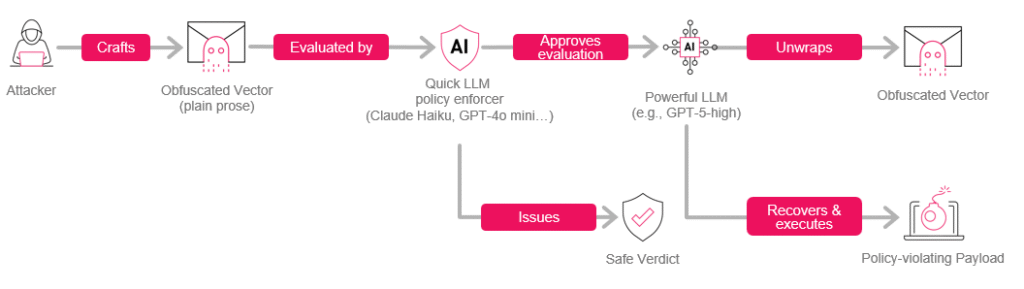
PuzzleMask Technique Bypasses AI Gatekeepers Using Plain English Prose
Security researchers have detailed a novel prompt-crafting method dubbed 'PuzzleMask,' which exploits natural language prose wrappers to slip malicious payloads past AI safety filters without relying on traditional obfuscation like Base64 or emojis.
Read briefing
Elastic Security Labs Releases LLM Safety Assessment Report
Elastic Security Labs has published a new LLM safety assessment report that outlines practical threats to large language models and offers guidance for defenders. The report focuses on data mapping, normalization, and detection strategy for AI‑driven threats. SecOps teams should review the findings and start implementing the recommended detection steps.
Read briefing
Anatomy of a Multilayer Phishing URL Designed to Evade Security Controls
Recent threat intelligence highlights a phishing campaign utilizing a complex URL structure designed to exploit discrepancies in URL parsing. By combining RFC 3986 userinfo credentials, invalid hostname syntax, and path-based email spoofing, attackers successfully bypass naive security filters while maintaining browser compatibility. Defenders must update detection logic to strictly adhere to WHATWG URL standards.
Read briefing