
Threat Intel
Mass Scans Target Exposed Vite Development Servers for Cloud Secrets
A new wave of attackers is hunting internet‑exposed Vite dev servers for AWS and Azure credentials, using the recently disclosed CVE‑2026‑39364 to bypass file‑access controls. Over 800 attacks were logged by F5, with attackers leveraging Google Cloud IP ranges and exploiting additional Vite CVEs. The campaign focuses on .env files, AWS config, Terraform state, and serverless configs. RootPwn recommends updating Vite to 8.0.5 or later, blocking port 5173, filtering /@fs/ requests, and rotating any secrets exposed by vulnerable instances.

Developers who expose Vite’s default localhost server to the internet are suddenly on the front page of a new threat campaign. Over the past month, F5’s honeypot sensors recorded more than 800 distinct attacks aimed at Vite instances that had been left publicly reachable.
How the Attack Works
At the heart of the operation is CVE‑2026‑39364, a high‑severity flaw that lets an unauthenticated attacker craft a GET request with special query parameters—such as ?raw, ?import&raw, or ?import&url&inline—to bypass Vite’s file‑access checks. The server then returns the requested file with a 200 status code, effectively leaking any file that should be protected.
Targeted Secrets
Once inside, the attackers run exhaustive wordlists against common secret locations: .env files, AWS credential and config files, Azure tokens, Terraform state, and serverless configuration files. They also probe /proc/self/environ and /etc/passwd for additional clues.
Who’s Behind It
Most of the malicious traffic originates from IP ranges owned by Google Cloud, with the highest activity coming from the United States, Belgium, and the Netherlands. The attackers also exploit older Vite CVEs—CVE‑2025‑30208, CVE‑2025‑31125, and CVE‑2024‑45811—showing a pattern of opportunistic exploitation.
Mitigation Steps
- Upgrade Vite to the latest release (8.0.5 or newer) to patch CVE‑2026‑39364 and related flaws.
- Never expose the dev server to the internet; keep it bound to
localhostor use a reverse proxy that blocks external access. - Block traffic to port
5173and filter out suspicious/@fs/requests. - Avoid trusting crawler User‑Agent strings; enforce strict authentication or rate limiting.
- If a Vite instance is publicly exposed, rotate all cloud credentials that could have been accessed.
“The attackers are using Google Cloud IP ranges to hide behind legitimate traffic, making it harder for defenders to spot the scans,” notes F5 security researchers.
Related vulnerabilities

SAP Exposes Critical Kernel & Message Server Flaws: CVE-2026-44756 & CVE-2026-58240
SAP’s September Security Patch Day revealed two critical vulnerabilities that can be exploited remotely without authentication. The memory‑corruption flaw in SAP Extended Passport (OVERPASS, CVE‑2026‑44756) and the missing‑auth bug in NetWeaver Message Server (S4GET, CVE‑2026‑58240) both allow attackers to run arbitrary OS commands as the SAP installation user, risking full system takeover. Immediate application of SAP Security Notes 3747649 and 3759472 is mandatory.
Read briefing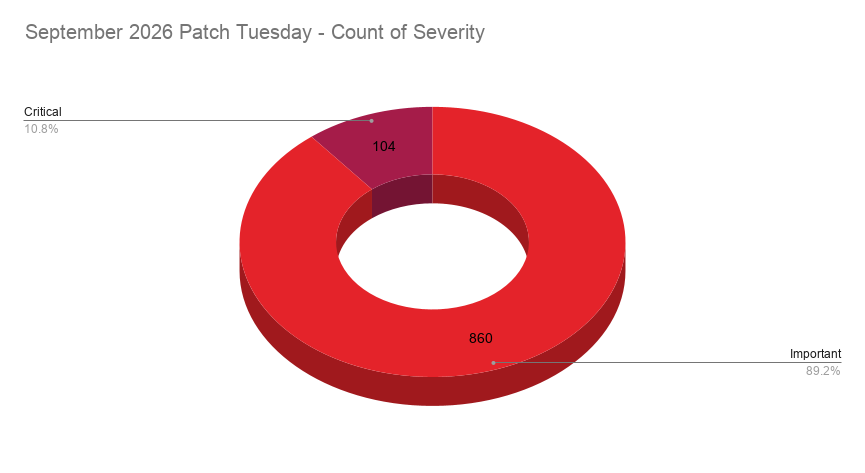
Microsoft September 2026 Patch Tuesday: 964 CVEs, Including Two Zero-Day Exploits (CVE-2026-81963, CVE-2026-85880)
Microsoft released its largest Patch Tuesday to date, addressing 964 CVEs—104 critical and 860 important—including two zero‑day vulnerabilities exploited in the wild. Defenders must prioritize applying updates to affected components such as .NET, Active Directory services, Azure services, Office, and Windows kernel drivers, and verify system integrity.
Read briefing
OpenOffice Versions <4.1.17 Vulnerable to Remote Code Execution (CVE‑2026‑59265, CVE‑2026‑63277)
Multiple CVEs have been identified in OpenOffice versions older than 4.1.17 that enable remote code execution. The flaws allow an attacker to trigger arbitrary code on a target system via crafted documents. Defenders must apply the vendor’s patches immediately or upgrade to a supported release.
Read briefing
OpenSSL and WolfSSL Patch High‑Severity DTLS Vulnerabilities (CVE‑2026‑84782, CVE‑2026‑84783)
OpenSSL and WolfSSL released updates fixing a dozen critical bugs, including CVE‑2026‑84782 that lets unauthenticated attackers leak heap fragments or crash DTLS sessions. The flaw can be triggered during a DTLS handshake and is exploitable over the network without credentials. Defenders should upgrade to the latest releases and verify DTLS configurations.
Read briefing