
Threat Intel
Operation Blackout: Lessons for SecOps from the Dismantling of West African Scam Networks
Operation Blackout was a coordinated law‑enforcement effort that shut down a network of scam centers in West Africa. The operation demonstrates the power of public‑private collaboration and provides concrete steps for defenders to harden against similar threats. SecOps teams should review their threat‑intel feeds, patch management, and incident‑response playbooks in light of these findings.

What Happened
In late October 2026, the United Kingdom’s National Crime Agency, the U.S. Department of Justice, the FBI, and several technology firms joined forces in a joint operation dubbed Operation Blackout. The goal was to locate, seize, and dismantle a coordinated network of online scam centers operating from multiple sites in West Africa. The operation involved coordinated raids, digital forensics, and the seizure of servers, domain registrations, and financial accounts linked to the criminal enterprise.
The teams leveraged shared threat‑intel feeds, cross‑border legal agreements, and real‑time communication channels to synchronize actions across time zones. Within days, the operation identified more than 30 active phishing sites, 15 compromised corporate email accounts, and a series of cryptocurrency wallets used to launder proceeds. The coordinated effort also disrupted the infrastructure that enabled the scammers to host malicious payloads and distribute phishing kits.
Who Is Affected
While the primary targets were the scam operators, the operation exposed a broader ecosystem of compromised assets. Victims included small‑to‑medium businesses that received spear‑phishing emails, individuals who fell for fake investment offers, and financial institutions that processed fraudulent transactions. The operation also highlighted the vulnerability of organizations that rely on third‑party hosting services in regions with weaker regulatory oversight.
Defenders across the globe are at risk because the same tactics, techniques, and procedures (TTPs) used by the West African scam network are common in other cyber‑crime operations. The attackers employed low‑cost phishing kits, compromised legitimate websites, and leveraged social‑engineering to bypass multi‑factor authentication. Any organization that has not hardened its email gateways, endpoint detection, or user‑training programs could become an easy target.
Impact
The immediate impact was the removal of a significant portion of the scam infrastructure. Law‑enforcement seized servers, seized domain names, and froze cryptocurrency wallets, effectively cutting off the criminals’ ability to operate. The operation also sent a strong message to other cyber‑criminal groups that cross‑border collaboration can neutralize their operations.
From a defender perspective, the operation underscored the importance of maintaining up‑to‑date threat‑intel feeds and having the ability to act on them quickly. The rapid seizure of assets demonstrated that timely intelligence can prevent large‑scale phishing campaigns from reaching end users. The operation also exposed gaps in many organizations’ incident‑response readiness, especially in the areas of phishing detection and remediation.
Exposure
Analysis of the seized data revealed that the scam network relied heavily on compromised web hosting providers, shared hosting plans, and free SSL certificates. The attackers used a mix of open‑source phishing frameworks and custom scripts to generate credential‑harvesting pages. They also employed domain generation algorithms (DGAs) to rotate malicious domains, making it difficult for defenders to block them without real‑time updates.
Furthermore, the operation exposed the use of compromised corporate email accounts as a launchpad for phishing. Attackers had gained access through credential stuffing and weak password policies. Once inside, they used the accounts to send mass emails that appeared legitimate, leveraging the trust of the organization’s brand. This highlights the need for continuous monitoring of outbound email traffic and the enforcement of strict password hygiene.
What to Do
- Integrate real‑time threat‑intel feeds that include phishing URLs, malicious IPs, and DGA domain patterns into your email and web filtering solutions.
- Implement multi‑factor authentication for all privileged accounts and enforce strong, unique passwords for all user accounts.
- Deploy an endpoint detection and response (EDR) solution that can detect credential‑harvesting scripts and suspicious network connections.
- Regularly audit and patch web hosting environments, especially shared hosting accounts, to remove known vulnerabilities that can be exploited for phishing.
- Establish a rapid incident‑response playbook that includes steps for isolating compromised email accounts, revoking credentials, and notifying affected users.
- Conduct quarterly phishing simulation exercises to test user awareness and refine training programs.
What to Watch
Defenders should keep an eye on emerging phishing kits that incorporate AI‑generated content, as these can bypass traditional content filters. The operation also highlighted the growing use of cryptocurrency mixers to launder proceeds, so monitoring for suspicious wallet activity remains critical.
Additionally, watch for new DGA families that may surface as attackers attempt to re‑establish infrastructure after disruptions. Staying ahead of these patterns requires continuous collaboration with law‑enforcement and industry partners, as demonstrated by Operation Blackout.
Related articles

Digital Forensics Corp. Fraud: $60M in Sextortion Scam
Digital Forensics Corporation (DFC) scammed victims of sextortion by charging up to $20,000 for nonexistent services, amassing at least $60 million between 2023 and 2026. The FTC has issued a temporary injunction and warns defenders to verify third‑party claims and report fraud.
Read briefing
Volt Typhoon Deploys Silent Train Framework to Execute Zero‑Day Attacks on Critical Infrastructure
Chinese state‑sponsored group Volt Typhoon has been using the Silent Train framework to launch zero‑day attacks against high‑value targets, rotating chains of compromised devices and erasing traces after each operation. The attacks have hit telecommunications, government, utilities, and other critical sectors across the United States. Defenders should inventory devices, segment networks, enforce MFA, and monitor for anomalous device‑to‑device traffic.
Read briefing
Mobile Scam Vectors Evolve: SMS, AI Voice Cloning, and the 'Tone-Out' Effect
Scammers are exploiting the high open rates of SMS and the increasing realism of AI-generated voice clones to bypass user skepticism. With 85% of users reporting difficulty distinguishing legitimate requests from fraud, defenders must implement technical controls and verify identity through out-of-band channels rather than relying on user vigilance alone.
Read briefing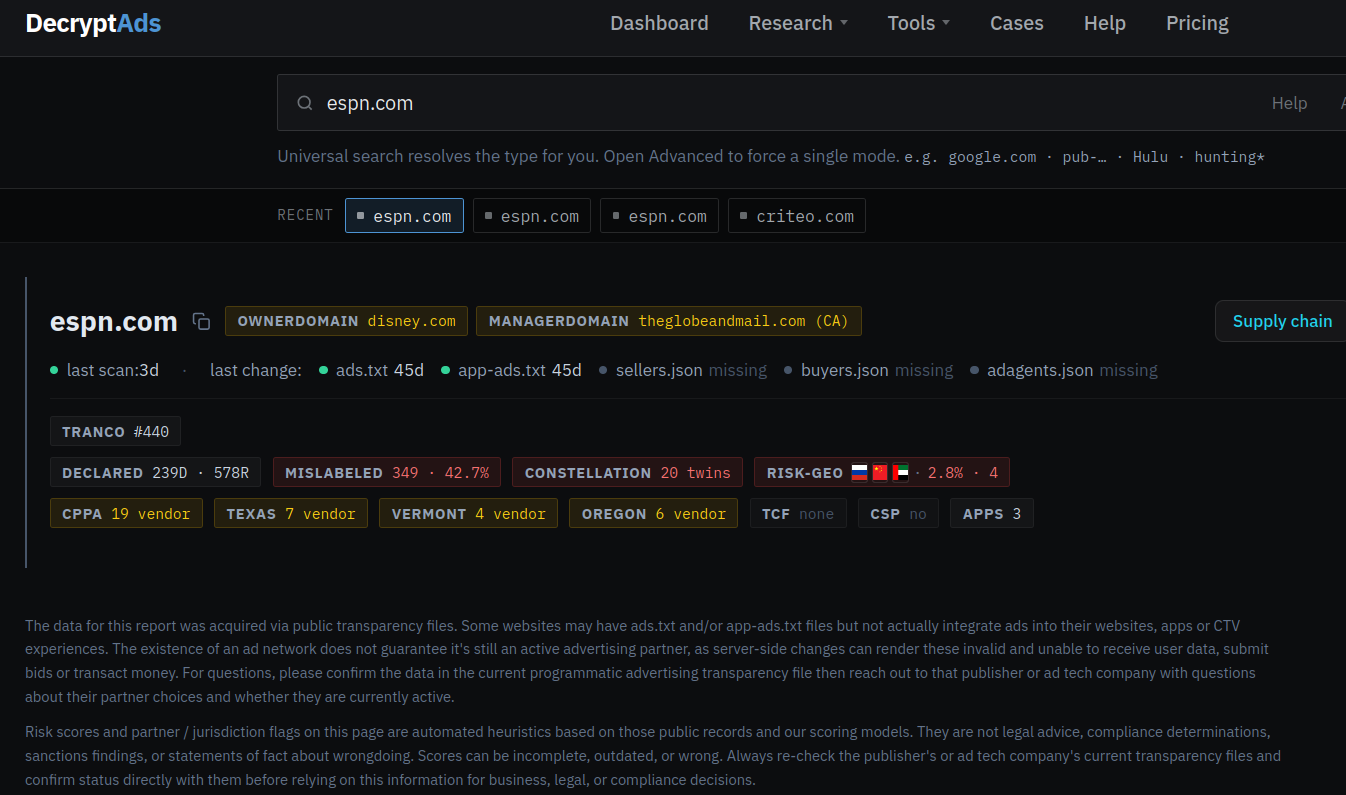
DecryptAds: New Service Maps Adtech Ecosystem for Security Teams
DecryptAds scrapes ads.txt, app‑ads.txt, buyers.json, and sellers.json from sites and apps to build a comprehensive view of who can serve ads or collect data. Security teams can use the data to spot malicious ad networks, adversarial actors, and supply‑chain gaps. The service is free and designed for privacy‑focused threat hunting.
Read briefing