
Threat Intel
AI-Driven Threats: Building Readiness in Security Operations
The latest webinar from Wiz highlights how AI accelerates attacker capabilities and stresses the need for unified threat context. Security teams must prioritize exposures, map attack paths, and automate remediation to keep pace. The briefing outlines actionable steps and future trends for SecOps defenders.
What Happened
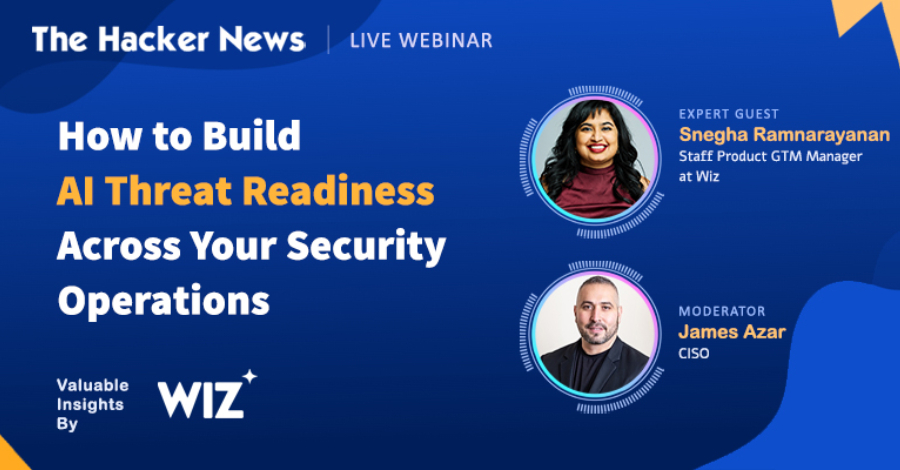
The Hacker News announced a webinar titled "How to Build AI Threat Readiness Into Your Security Operations" featuring a Wiz expert. The session, scheduled for the following week, focuses on the evolving threat landscape where advanced AI models enable attackers to discover vulnerabilities, generate exploit code, and traverse systems faster than traditional detection pipelines.
During the webinar, the speaker will demonstrate how security teams can leverage unified security context to separate urgent exposures from background noise, understand attack paths, and integrate security agents into investigation and remediation workflows. The goal is to shorten the time from detection to action, a critical metric as attackers increasingly automate discovery and exploitation.
Who Is Affected
SecOps personnel, system administrators, and incident response teams are directly impacted. Any organization that relies on vulnerability scanners, cloud monitoring, identity analytics, or application telemetry will face the same challenge: connecting disparate signals quickly enough to drive action.
Large enterprises with complex cloud environments, multi‑tenant SaaS deployments, and extensive software supply chains are especially vulnerable. Smaller teams that lack centralized visibility or automated remediation pipelines will struggle to keep pace with AI‑assisted attacks.
Impact
AI‑powered adversaries can now map attack surfaces, generate zero‑day exploits, and pivot through systems at speeds that outstrip manual triage. This reduces the window defenders have to respond, turning a once manageable detection problem into a race against automated threat actors.
Consequences include increased breach likelihood, higher data exfiltration volumes, and amplified operational costs due to prolonged incident investigations. Organizations that fail to adapt risk falling behind in both detection and response capabilities.
Exposure
Exposures now span cloud infrastructure, code repositories, identity configurations, SaaS integrations, AI services, and the software supply chain. A single misconfigured cloud bucket or an unpatched container image can become a launchpad for automated attacks.
Attackers can chain these exposures, moving from a low‑impact asset to a high‑value target by leveraging AI to identify the most promising paths. The result is a cascading effect that can compromise sensitive data, disrupt services, and erode trust.
What to Do
Defenders must adopt a unified context approach that aggregates all security signals into a single view. This enables rapid assessment of which exposures are reachable, contain sensitive data, and are owned by the correct stakeholders.
Concrete actions include:
- Implement a centralized dashboard that correlates vulnerability findings, cloud alerts, identity signals, and threat detections.
- Automate path analysis to identify exploitable chains and prioritize remediation based on reachability and data sensitivity.
- Integrate security agents into existing ticketing or SOAR platforms to route findings directly to the responsible owners.
- Establish clear ownership and escalation policies for each asset type to reduce investigation time.
- Schedule regular threat hunting sessions that focus on AI‑generated attack vectors and validate detection coverage.
What to Watch
Future threat intelligence will increasingly rely on AI to predict attacker behavior. Security teams should monitor developments in generative models that can produce custom exploit code, as well as tools that automate lateral movement.
Organizations should also keep an eye on regulatory requirements around AI‑driven risk assessments and the emergence of standards for unified threat context. Staying ahead of these trends will be essential for maintaining a defensible posture in an AI‑enabled threat landscape.
Related vulnerabilities

AI in Cybersecurity: Current Trends, Challenges, and How Defenders Can Respond
AI is accelerating the evolution of cyber threats and defensive capabilities. This briefing outlines how security teams can leverage AI-driven platforms, the emerging trends in threat intelligence, and the key challenges to overcome. Defenders should prioritize integration, continuous monitoring, and skill development to stay ahead.
Read briefing
Elastic Security Labs Releases LLM Safety Assessment Report
Elastic Security Labs has published a new LLM safety assessment report that outlines practical threats to large language models and offers guidance for defenders. The report focuses on data mapping, normalization, and detection strategy for AI‑driven threats. SecOps teams should review the findings and start implementing the recommended detection steps.
Read briefing
CrowdStrike Expands Falcon Adversary OverWatch to Cover AI Workloads and Google Cloud Threat Hunting
CrowdStrike has extended its Falcon Adversary OverWatch managed threat hunting service to include 24/7 coverage of AI applications and autonomous agents, as well as enhanced telemetry‑driven hunting for Google Cloud environments. The update provides defenders with deeper visibility into AI‑driven attacks and cloud‑native threats, enabling faster detection and response. Security teams should enable the new features, review agent telemetry, and adjust monitoring policies accordingly.
Read briefing
AI Guardrails Reveal Vulnerabilities: Prompt Injection and Agent-Planning Threats
AI guardrails designed to prevent malicious use of language models are now being weaponized through prompt injection and agent-planning attacks. The latest techniques expose new attack vectors that can bypass existing security controls and enable sophisticated espionage campaigns. Defenders must update guardrail policies, monitor for injection patterns, and harden AI-driven platforms to mitigate these threats.
Read briefing