
Threat Intel
Cisco SD‑WAN Zero‑Day Exploit Used by Volt Typhoon’s Silent Train to Steal Encryption Keys
A critical Cisco SD‑WAN vulnerability (CVE‑2026‑20127) was leveraged by a threat actor linked to China’s Volt Typhoon program. The attackers deployed KeyDrift malware to harvest encryption keys and modify SD‑WAN configurations. Immediate patching and monitoring are essential for all SD‑WAN deployments.

What Happened
Cisco Talos identified that a zero‑day flaw in the SD‑WAN controller (CVE‑2026‑20127) was exploited by a threat actor whose infrastructure overlaps with the covert Silent Train network used by Volt Typhoon. The vulnerability allows remote attackers to bypass peering authentication and gain administrative privileges on SD‑WAN controllers without any credentials.
Once inside, the actors installed KeyDrift, a key‑stealing payload that captures VPN and TLS session keys. The same day, Lumen’s Black Lotus Labs released a detailed analysis of Silent Train, confirming that the same CVE was used in a broader zero‑day campaign targeting U.S. organizations in the aerospace, defense, and space sectors.
Who Is Affected
All organizations running Cisco SD‑WAN vEdge appliances and SD‑WAN controller software are at risk. The flaw is not limited to a specific firmware version; it exists in all releases that have not been patched since the February 2026 disclosure.
Customers with multi‑site SD‑WAN deployments, especially those using the default peering configuration, are the most vulnerable. The threat actor’s use of the Silent Train infrastructure suggests that U.S. government agencies, defense contractors, and satellite operators are high‑priority targets.
Impact
Compromise of the SD‑WAN controller grants attackers full control over the network fabric. They can alter routing policies, redirect traffic, and install additional malware on downstream devices.
KeyDrift’s ability to harvest encryption keys exposes all encrypted VPN tunnels and TLS sessions, potentially allowing attackers to decrypt traffic, exfiltrate data, and maintain persistence within the network.
Exposure
The CVE was publicly disclosed in February 2026, but many deployments remain unpatched due to legacy firmware or misconfigured update policies. The vulnerability does not require user interaction or local access, making it highly suitable for automated attacks.
Silent Train’s infrastructure is designed for stealth, using compromised servers and dynamic IP rotation. This makes detection difficult and allows the threat actor to maintain a foothold for extended periods.
What to Do
- Apply the latest Cisco SD‑WAN firmware and controller patches immediately. Verify that the patch includes the fix for CVE‑2026‑20127.
- Re‑configure SD‑WAN peering to use mutual TLS with strong, unique certificates and disable any default or weak authentication mechanisms.
- Implement strict network segmentation so that SD‑WAN controllers are isolated from general network traffic and only reachable by authorized management IPs.
- Enable comprehensive logging on SD‑WAN controllers and forward logs to a SIEM. Look for anomalous configuration changes, unexpected key‑generation events, or unfamiliar processes.
- Deploy endpoint detection and response (EDR) on all devices that connect to the SD‑WAN fabric to detect lateral movement or the presence of key‑stealing payloads.
- Conduct a full audit of VPN and TLS certificates to ensure they are not compromised and rotate them if necessary.
What to Watch
Monitor for new variants of KeyDrift or similar key‑stealing malware that may target other network appliances. Attackers often evolve their payloads to bypass updated defenses.
Stay alert for indicators of compromise (IOCs) related to Silent Train, such as known malicious IP ranges, domain suffixes, or hash values. Subscribe to Cisco Talos and Lumen threat feeds for real‑time updates.
Related vulnerabilities

GreyNoise Detects Pre-Disclosure Targeting Surges for 33 CVEs, Including Cisco CVE-2026-20127
GreyNoise sensors recorded eight distinct targeting surges for Cisco’s CVE‑2026‑20127 before the vendor’s advisory, with a median lead time of 11 days across 33 vulnerabilities. The study shows session volume spikes as the strongest early warning, enabling defenders to pre‑empt zero‑day exploitation. SecOps teams should monitor session volume and ASN activity for vendor‑specific tags to identify imminent threats.
Read briefing
Volt Typhoon Deploys Silent Train Framework to Execute Zero‑Day Attacks on Critical Infrastructure
Chinese state‑sponsored group Volt Typhoon has been using the Silent Train framework to launch zero‑day attacks against high‑value targets, rotating chains of compromised devices and erasing traces after each operation. The attacks have hit telecommunications, government, utilities, and other critical sectors across the United States. Defenders should inventory devices, segment networks, enforce MFA, and monitor for anomalous device‑to‑device traffic.
Read briefing
SAP Exposes Critical Kernel & Message Server Flaws: CVE-2026-44756 & CVE-2026-58240
SAP’s September Security Patch Day revealed two critical vulnerabilities that can be exploited remotely without authentication. The memory‑corruption flaw in SAP Extended Passport (OVERPASS, CVE‑2026‑44756) and the missing‑auth bug in NetWeaver Message Server (S4GET, CVE‑2026‑58240) both allow attackers to run arbitrary OS commands as the SAP installation user, risking full system takeover. Immediate application of SAP Security Notes 3747649 and 3759472 is mandatory.
Read briefing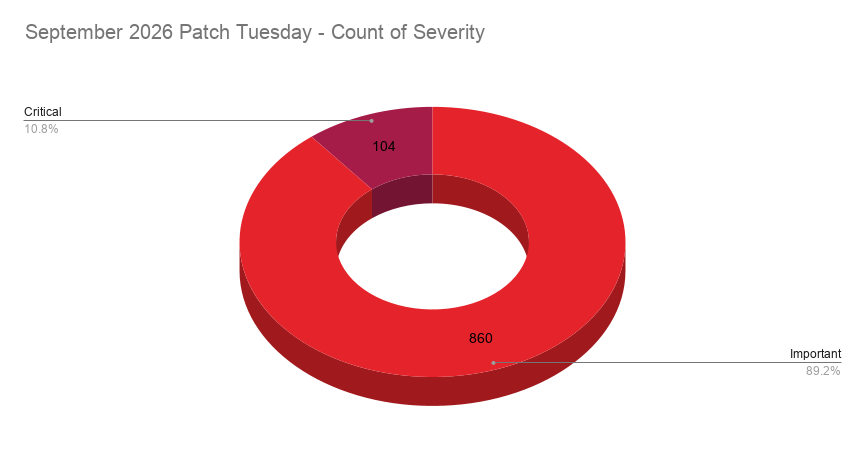
Microsoft September 2026 Patch Tuesday: 964 CVEs, Including Two Zero-Day Exploits (CVE-2026-81963, CVE-2026-85880)
Microsoft released its largest Patch Tuesday to date, addressing 964 CVEs—104 critical and 860 important—including two zero‑day vulnerabilities exploited in the wild. Defenders must prioritize applying updates to affected components such as .NET, Active Directory services, Azure services, Office, and Windows kernel drivers, and verify system integrity.
Read briefing