
Advisories
Rockwell Automation RSLinx Classic v≤4.50 Suffers Multiple High‑Severity DoS Flaws (CVE‑2026‑9621‑9625)
Rockwell Automation’s RSLinx Classic software, used widely in critical manufacturing, now carries four CVEs that can be exploited to crash the service via malformed CIP packets. Versions 4.50 and older are affected; the vendor has released a patch in 4.60. Operators must upgrade or apply the recommended best‑practice mitigations to prevent denial‑of‑service incidents.
Industrial control systems have a new threat vector: Rockwell Automation’s RSLinx Classic software is vulnerable to a series of denial‑of‑service (DoS) attacks. Attackers can send crafted CIP packets that trigger integer overflows, buffer overflows, or underflows, causing the RSLinx service to crash and requiring a restart.
Vulnerabilities
- CVE‑2026‑9621 – Improper handling of malformed packets leads to a classic buffer overflow.
- CVE‑2026‑9622 – Crafted packets targeting the Forward Close service cause a service crash.
- CVE‑2026‑9624 – Integer underflow or wraparound in packet parsing can trigger a crash.
- CVE‑2026‑9625 – Additional integer overflow conditions that destabilize the service.
Impact
The exploitation of any of these CVEs results in a DoS condition. The RSLinx Classic service terminates unexpectedly, leaving connected control systems offline until the service is manually restarted. In critical manufacturing environments, this can lead to production downtime and safety risks.
Affected Versions
- RSLinx Classic ≤ 4.50
Vendor Fix
Rockwell Automation has released version 4.60, which addresses all four CVEs. The patch removes the vulnerable packet parsing logic and adds bounds checking to prevent overflows.
Mitigation for Non‑Upgradable Systems
- Apply Rockwell Automation’s recommended security best practices for RSLinx Classic.
- Restrict network access to the RSLinx service, limiting exposure to trusted IP ranges.
- Enable logging and monitor for abnormal packet traffic patterns.
- Consider isolating the RSLinx service in a separate network segment.
Operators should prioritize upgrading to version 4.60 as soon as possible to eliminate the risk of service disruption.
Related vulnerabilities
Rockwell Automation Historian ME Exposes Remote Code Execution & DoS via Out‑of‑Bounds Buffer Overflows
Two high‑severity vulnerabilities in Rockwell Automation’s FactoryTalk Historian Machine Edition (Historian ME) allow attackers with low‑level authentication to crash the device or, in one case, execute arbitrary code. Affected Series B 5.202 and Series C 7.101 are impacted. The flaws, CVE‑2025‑12768 and CVE‑2026‑12661, pose a risk to critical infrastructure sectors worldwide. Immediate mitigation is advised, with upgrade or adherence to Rockwell’s security best practices. Contact the PSIRT team at [email protected] for assistance.
Read briefing
SAP Exposes Critical Kernel & Message Server Flaws: CVE-2026-44756 & CVE-2026-58240
SAP’s September Security Patch Day revealed two critical vulnerabilities that can be exploited remotely without authentication. The memory‑corruption flaw in SAP Extended Passport (OVERPASS, CVE‑2026‑44756) and the missing‑auth bug in NetWeaver Message Server (S4GET, CVE‑2026‑58240) both allow attackers to run arbitrary OS commands as the SAP installation user, risking full system takeover. Immediate application of SAP Security Notes 3747649 and 3759472 is mandatory.
Read briefing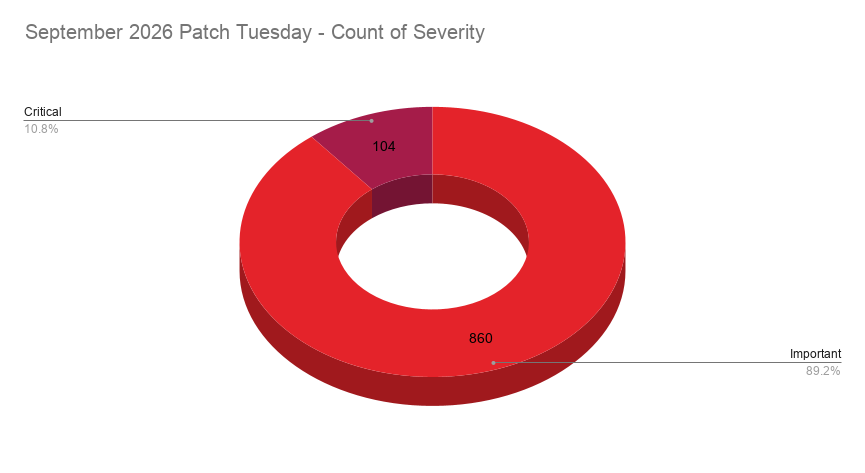
Microsoft September 2026 Patch Tuesday: 964 CVEs, Including Two Zero-Day Exploits (CVE-2026-81963, CVE-2026-85880)
Microsoft released its largest Patch Tuesday to date, addressing 964 CVEs—104 critical and 860 important—including two zero‑day vulnerabilities exploited in the wild. Defenders must prioritize applying updates to affected components such as .NET, Active Directory services, Azure services, Office, and Windows kernel drivers, and verify system integrity.
Read briefing
Adobe June 2026 Patch Tuesday: 11 Bulletins, 123 CVEs, CVSS 10.0 in Campaign Classic
Adobe released 11 security bulletins in June 2026, addressing 123 CVEs across multiple products. The highest severity CVSS 10.0 is in Campaign Classic, with other critical CVEs in ColdFusion and Acrobat Reader. Defenders should prioritize patching Campaign Classic first, then ColdFusion and Acrobat Reader, and monitor for exploitation.
Read briefing