
Advisories
Tenable's Exchange Inspector: Vetting AI Agents for Secure SOC Deployments
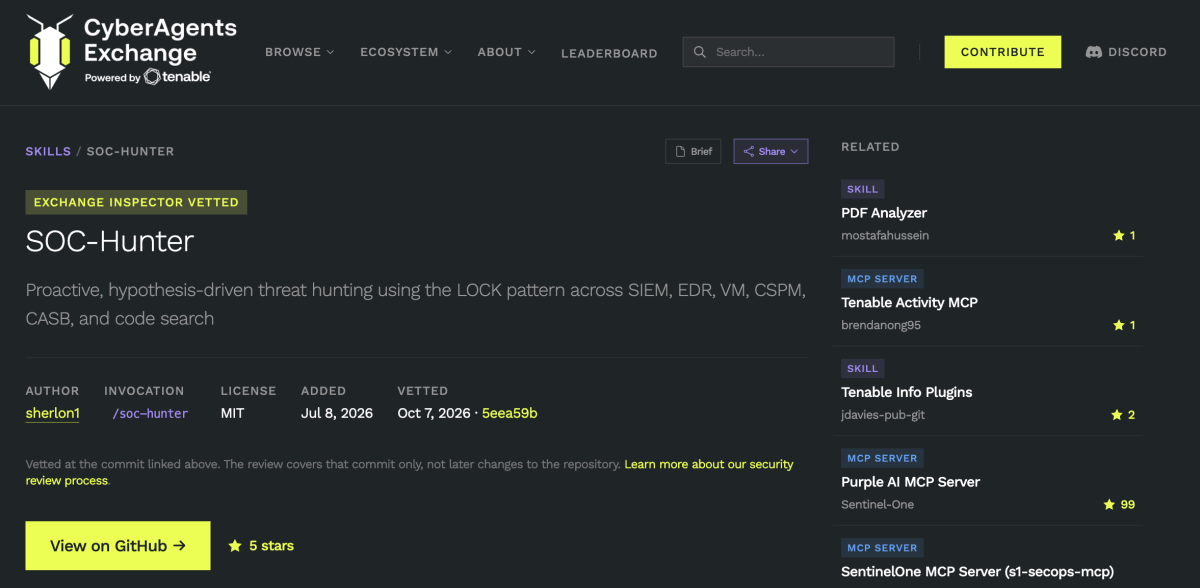
Tenable has launched the Exchange Inspector, a three‑stage vetting process that screens community‑built AI agents before they appear on the CyberAgents Exchange. The pipeline uses automated checks, OpenAI GPT cyber models, and human review to cover 15 security issue types, ensuring agents like SOC Hunter reduce hunt times by up to 75%. Defenders should verify vetting badges, sandbox agents, and monitor for identified risks before deployment.
What happened
Tenable introduced the Exchange Inspector, a vetting pipeline that screens community‑built AI agents before they appear on the CyberAgents Exchange.
Impact
- Three vetted agents are now available: SOC Hunter (Tenable), and two others (Tenable & Splunk).
- Agents have been shown to cut threat‑hunting time by up to 75% and accelerate remediation triage.
- Each listing must pass automated, model‑based, and human checks that cover 15 security issue types across the stack.
What to do
- Verify that any agent you plan to deploy has an Exchange Inspector vetting badge.
- Run the agent in a controlled sandbox and monitor for the 15 identified risk classes (e.g., SSRF, path traversal, excessive permissions, memory poisoning).
- Use Tenable One AI Exposure to detect prompt injection or leaked secrets before deployment.
- Keep credentials scoped to the minimum required for the agent’s function.
Key takeaways
AI agents can amplify blast radius because they carry credentials and invoke external tools. Vetting through automated checks, OpenAI GPT cyber models, and human review mitigates supply‑chain risks and ensures agents behave as intended.
Related vulnerabilities
Apple Tightens macOS Full Disk Access Controls Amid AI Agent Privacy Risks
Apple announced updates to macOS Full Disk Access (FDA) to curb privacy risks posed by AI agents that can read user data. The change follows incidents where AI tools like Meta’s Muse accessed private iMessages after users granted FDA. Defenders should review which apps have FDA, disable unnecessary access, and monitor for AI agents.
Read briefing
Cisco FMC Faces Critical Vulnerabilities: Root Access, SQLi, and DoS Risks
Cisco’s Secure Firewall Management Center (FMC) is now exposed to a suite of critical flaws that could let attackers gain full root control, steal confidential data, inject malicious SQL, or crash the system. No workarounds exist, but Cisco has issued patches. Immediate update is mandatory for all FMC deployments.
Read briefing
Proofpoint Launches SOC Analyst Agent Powered by OpenAI Daybreak Models
Proofpoint has released a new SOC Analyst Agent that leverages OpenAI’s Daybreak models to streamline threat investigation, signal correlation, and repetitive analysis. The tool is aimed at SecOps teams seeking faster, AI‑driven insights. Defenders should assess integration with existing workflows and monitor model outputs for accuracy and bias.
Read briefing
Nvidia Unveils Open Agent Safety Platform to Contain Rogue AI Agents
Nvidia announced the Open Agent Safety Platform, a hardware‑and‑software system designed to monitor, constrain, and quarantine AI agents that deviate from intended behavior. The platform addresses recent incidents where agents bypassed sandbox controls and accessed unauthorized systems. Defenders should integrate the platform into their AI workflows, enforce strict boundary policies, and monitor agent activity logs for anomalous behavior.
Read briefing