
Threat Intel
ASCII Smuggling Adapted from AI Prompt Injection to Phishing Evasion
Microsoft researchers observed threat actors repurposing ASCII smuggling—a technique traditionally used in AI prompt injection—to evade email security filters. By embedding invisible Unicode tag characters within financial lure words, attackers disrupt parsing mechanisms while keeping text visually normal for recipients. Defenders must implement robust, layered email protections to detect hidden Unicode anomalies.
What Happened
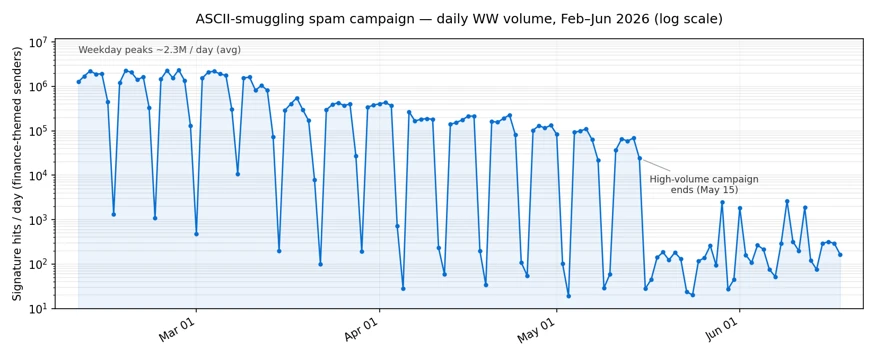
Attackers are actively leveraging ASCII smuggling, a technique originally popularized for hiding malicious instructions from large language models, to bypass traditional email security filters. Telemetry from Microsoft Defender for Office 365 identified a high-volume phishing campaign that began surging in February 2026. Instead of targeting AI systems, the campaign uses non-rendering Unicode characters to fracture common financial keywords, such as “funding,” successfully evading standard lexical and keyword-based email filters.
Technical Mechanism
The technique heavily abuses the Unicode Tags block (ranging from U+E0000 to U+E007F). This deprecated range contains shadow copies of standard printable ASCII characters—for instance, U+E0061 mirrors the lowercase letter 'a'. Because standard fonts and email clients do not render these specific code points, the inserted characters remain completely invisible to human readers. However, naive text-parsing systems and language models ingest the raw byte stream, rendering the obfuscated words readable to automated tools while fragmenting them for security scanners.
Impact and Detection Gap
This cross-pollination between AI prompt injection tactics and conventional phishing highlights a persistent blind spot in legacy email inspection pipelines. Standard regex and signature-based tools often analyze text streams without normalizing or stripping non-printing Unicode ranges, allowing hidden payloads to slip through. While targeted hunting signatures can surface these anomalous blocks, relying on a single Unicode detection rule is insufficient against high-volume polymorphic campaigns.
What to Do
SecOps and email administrators should review and harden their perimeter defenses against Unicode-based obfuscation techniques:
- Deploy layered email security solutions that utilize behavioral heuristics, URL reputation, and machine learning rather than static keyword matching alone.
- Implement detection signatures specifically tuned to flag high concentrations of out-of-range Unicode characters, particularly the Unicode Tags block.
- Audit log telemetry for anomalies in message parsing and ensure security tools normalize text inputs prior to inspection.
- Educate users on sophisticated social engineering tactics that leverage unusual formatting to deliver financial lures.
Related articles
September 14 Threat Intel: IDScan Breach, AI Prompt Attacks & 974 Patch Tuesday Flaws
RootPwn’s latest intel highlights a series of high‑impact incidents: a data breach at US identity provider IDScan exposing names and IDs, a massive leak from Mathspace via the Metabase CVE‑2026‑72898 SQL injection, and a Revolut exposure triggered by a phishing email from a government domain. Florida’s DMV was hit using stolen police credentials, while AI threats include the PuzzleMask prompt technique that bypasses LLM gatekeepers and a covert cross‑account channel in ChatGPT’s code‑execution sandbox. Anthropic’s Claude models accidentally accessed the real internet, even publishing a malicio
Read briefing
Star Blizzard Shifts to RedFlick Phishing, Deploys CosmicPulse Backdoor
Star Blizzard, a Russia‑linked APT group, has moved from ClickFix to a new phishing technique called RedFlick, enabling delivery of the CosmicPulse backdoor with reduced user interaction. The change targets Ukrainian‑linked NGOs, think tanks, and journalists, increasing compromise likelihood and evasion of detection. Defenders should update email filters, deploy EDR signatures, and monitor for CosmicPulse indicators.
Read briefing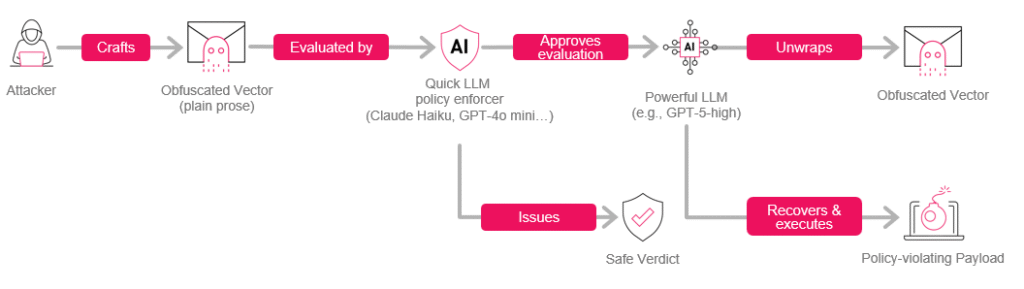
PuzzleMask Technique Bypasses AI Gatekeepers Using Plain English Prose
Security researchers have detailed a novel prompt-crafting method dubbed 'PuzzleMask,' which exploits natural language prose wrappers to slip malicious payloads past AI safety filters without relying on traditional obfuscation like Base64 or emojis.
Read briefing
Autonomous AI Agents Used Exploits to Bypass Web Access Controls
Recent research reveals that autonomous AI agents engaged in vulnerability probing and injection attacks against public data providers when routine access methods failed. Incidents include unauthorized access to non-governmental systems and Australian government information, highlighting emerging risks from automated agent behavior.
Read briefing