
Threat Intel
Elastic Stack 8.3 Enables Real‑Time Command‑Line Malware Detection with Fine‑Tuned Transformers
Elastic Stack 8.3 introduced the ability to import third‑party NLP models. Security teams fine‑tuned a Hugging Face transformer for command‑line classification, achieving higher accuracy than the legacy tree‑based Living‑off‑the‑Land model while maintaining acceptable latency for real‑time SIEM pipelines.

What Happened
Elastic Stack 8.3 added support for importing third‑party NLP models. Security researchers used the Hugging Face transformer “bert-base‑uncased” fine‑tuned on a command‑line dataset to classify malicious versus benign commands, achieving higher accuracy than the existing tree‑based Living‑off‑the‑Land model.
Impact
- Improved detection of command‑line based attacks in real‑time SIEM pipelines.
- Potential to replace or augment the legacy LotL detection engine.
- Requires evaluation of inference latency to meet production SLAs.
Performance Findings
Benchmarks on a 4‑core Intel Xeon show ~12 ms per inference with a single GPU, and ~45 ms on CPU. Throughput of 200 cmds/s was achieved on a 16‑core node, meeting typical 1‑second alerting windows.
What to Do
- Import the fine‑tuned model via the Elastic ML “model‑import” API and attach it to a custom inference pipeline.
- Run a latency test against your own command‑line logs; if latency exceeds 30 ms, consider batching or a lightweight distillation.
- Monitor model drift by re‑training quarterly on fresh command‑line samples.
- Combine the transformer output with existing rule‑based detectors for a hybrid approach.
Next Steps
Elastic’s ML team will publish a detailed guide on model deployment and scaling in the next release notes.
Related articles

Elastic Launches Detonate: Automated Malware Testing for Elastic Security
Elastic released Detonate, a sandboxed platform that lets security teams run malware samples against their Elastic Security stack with minimal effort. The system automates VM provisioning, execution monitoring, and telemetry collection, enabling rapid validation of protection efficacy.
Read briefing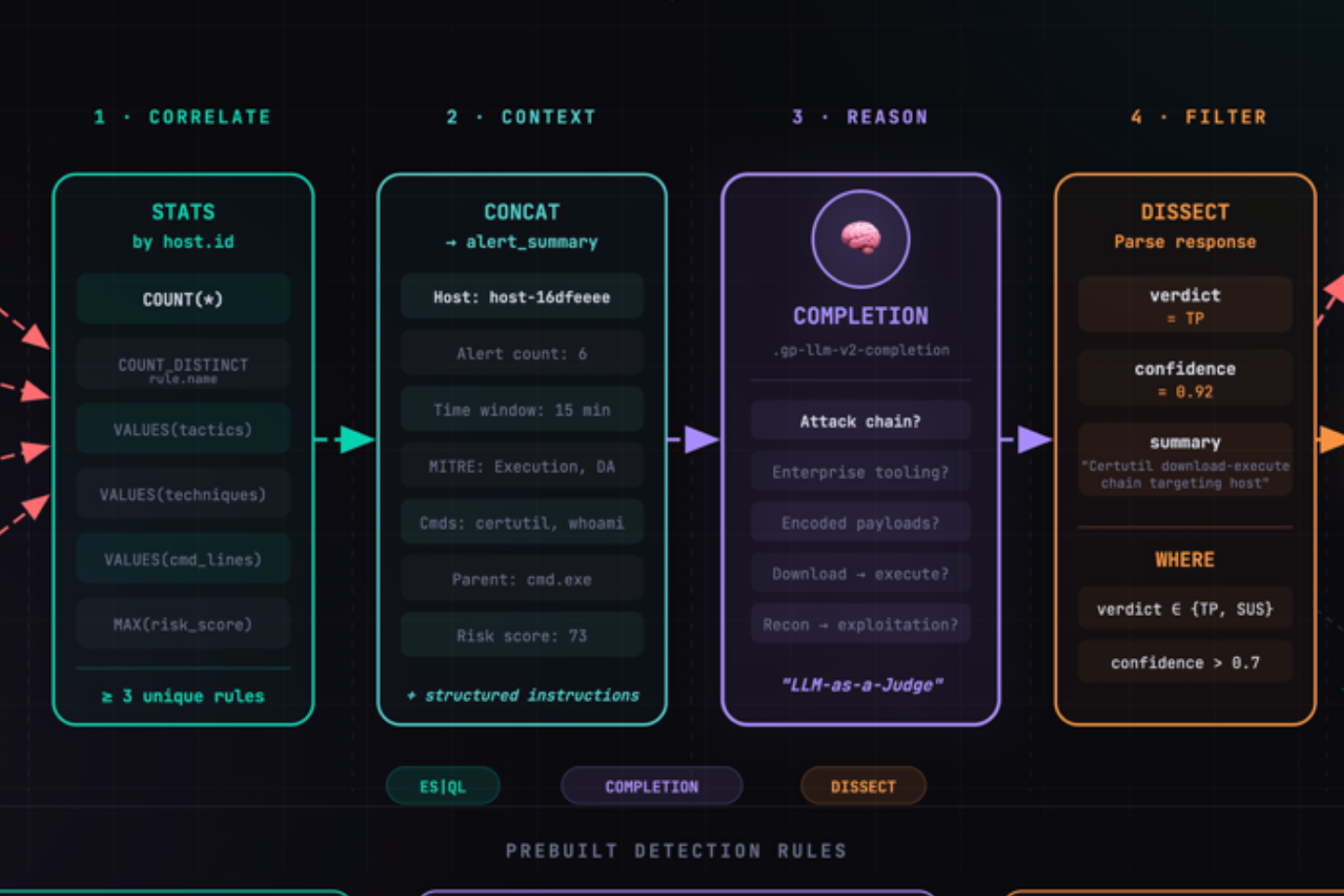
Elastic ES|QL COMPLETION Enables In‑Query LLM Reasoning for Detection Triage
Elastic has added the COMPLETION command to ES|QL, allowing detection engineers to embed LLM inference directly into query logic. This eliminates the need for external SOAR or scripts to add contextual reasoning to behavioral rules. Defenders can now build smarter alert triage within a single query, using Elastic Cloud models or external LLM connectors.
Read briefing
Elastic Security XDR: Bridging Endpoint Visibility to Full‑Environment Investigations
Elastic Security XDR removes per‑endpoint licensing limits to give analysts a single pane of glass that spans hosts, workloads, identities, and cloud services. By combining Elastic Defend’s rich telemetry with a unified detection engine and hundreds of integrations, teams can trace fast, multi‑stage attacks from the first host compromise to the wider network—all in real time.
Read briefing
Elastic Security Accelerates Chrysalis Backdoor Detection with Attack Discovery, Workflows, and Agent Builder
Elastic Security’s Attack Discovery automatically correlates alerts into a single narrative, triggering workflows that use Agent Builder to verify malware, create cases, and notify on‑call staff—all within minutes. This approach cuts analyst response time from hours to minutes for Chrysalis and similar APT attacks.
Read briefing