
Threat Intel
Operation Dream Job: From Job Offers to Zero‑Day Attacks on Defense Sectors
Check Point Research has traced a fresh wave of the Operation Dream Job campaign, a Lazarus‑linked effort that turns enticing job ads into a multi‑stage breach. The attackers now use a trojanized PDF viewer, the SecurityPDF app, to deliver a new kernel‑mode rootkit (FudModule) via the zero‑day CVE‑2026‑68820 in Microsoft’s AFD.sys driver. They also weaponize CVE‑2025‑49113 in Roundcube to plant RelayShell webshells, turning compromised servers into covert C2 relays. The campaign targets aerospace, aviation and defense firms worldwide, leveraging spear‑phishing, SEO‑boosted fake recruitment sit
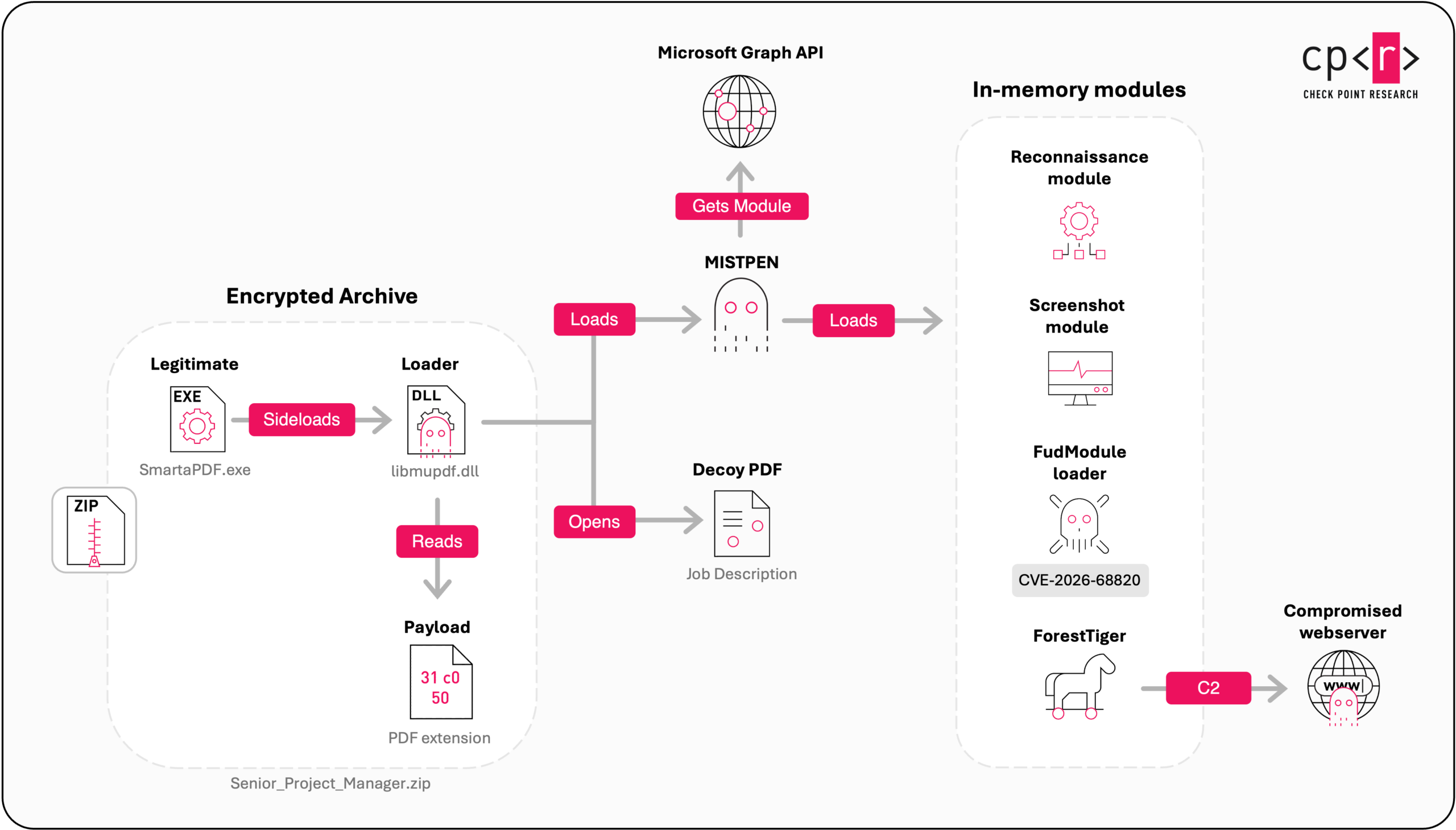
In the early months of 2026, a new wave of the long‑running Operation Dream Job campaign emerged, this time honing in on the defense, aerospace, and aviation industries. The attackers, linked to the DPRK‑affiliated Lazarus group, have refined their delivery tactics to look like legitimate recruitment outreach, turning a simple job offer into a weaponized zero‑day attack.
How the Attack Begins
- Spear‑phishing lures – Targets receive enticing job offers via LinkedIn, professional forums or direct messaging. The attackers pose as recruiters from well‑known defense contractors.
- Malicious download – Victims are directed to a spoofed recruitment site that hosts a trojanized PDF viewer called SecurityPDF. The site is SEO‑optimized to appear legitimate in search results.
- Execution – Opening a specially crafted PDF triggers the embedded payload, installing the first stage of the attack chain.
From User‑Space to Kernel‑Space
The initial payload drops a lightweight backdoor that leverages a newly discovered local privilege escalation (LPE) zero‑day, CVE‑2026‑68820, in Microsoft’s AFD.sys driver. Once SYSTEM privileges are achieved, the malware deploys FudModule, a custom kernel‑mode rootkit that hooks critical system calls and disables most endpoint detection and response (EDR) solutions.
Command‑and‑Control via Compromised Web Servers
Parallel to the kernel‑mode infection, the threat actor exploits CVE‑2025‑49113 in vulnerable Roundcube webmail installations. The resulting RelayShell PHP webshell turns the compromised mail server into a covert relay node, allowing the attackers to tunnel traffic through legitimate infrastructure and evade perimeter defenses.
Exploitation of the Defense Sector’s Reputation
In at least one documented instance, a Western European defense contractor’s compromised mail server was used to launch a spear‑phishing campaign. By leveraging the organization’s brand, the attackers were able to bypass user vigilance and deliver additional payloads to new victims.
Mitigation and Response
- Apply the August 2026 Patch Tuesday update that addresses CVE‑2026‑68820.
- Patch all Roundcube installations to the latest version to close CVE‑2025‑49113.
- Deploy host‑based intrusion detection capable of spotting kernel‑mode rootkits like FudModule.
- Implement strict email authentication (DMARC, SPF, DKIM) to reduce the effectiveness of spoofed recruitment emails.
- Monitor for unusual outbound traffic from webmail servers and enforce least‑privilege access controls.
“The campaign’s blend of social engineering, zero‑day exploitation, and server‑side relays demonstrates a sophisticated, multi‑layered approach that is hard to detect with traditional security tools,” said a Check Point Research analyst.
Related vulnerabilities
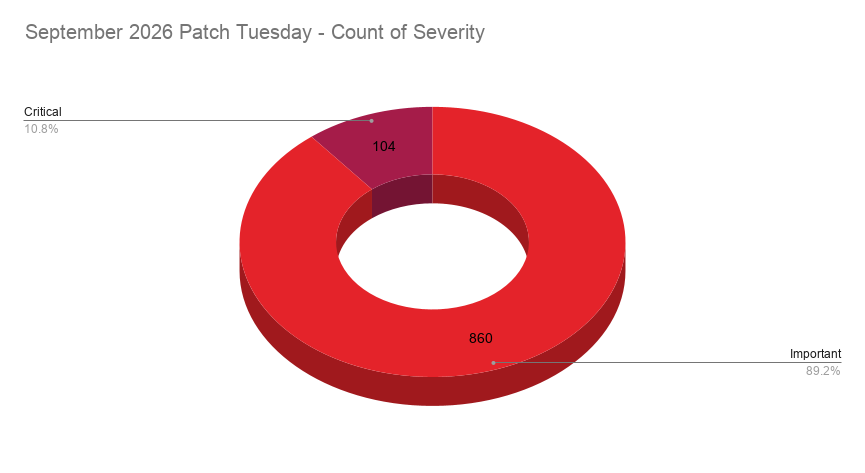
Microsoft September 2026 Patch Tuesday: 964 CVEs, Including Two Zero-Day Exploits (CVE-2026-81963, CVE-2026-85880)
Microsoft released its largest Patch Tuesday to date, addressing 964 CVEs—104 critical and 860 important—including two zero‑day vulnerabilities exploited in the wild. Defenders must prioritize applying updates to affected components such as .NET, Active Directory services, Azure services, Office, and Windows kernel drivers, and verify system integrity.
Read briefing
BeyondTrust Remote Support Zero‑Day CVE‑2026‑102764 Exploited by Armory Castle
A China‑linked threat actor, Armory Castle, used a CVE‑2026‑102764 zero‑day in BeyondTrust Remote Support to compromise a self‑hosted appliance on August 29, 2026. The flaw allows remote file operations via improper origin validation. All SaaS customers are patched; self‑hosted users must apply BT26‑05‑RS or upgrade.
Read briefing
Microsoft’s September Patch Tuesday: 972 CVEs, 113 Critical Flaws, 2 Zero‑Days Exploited in the Wild
On September 8, 2026 Microsoft rolled out 972 security updates, including 113 critical fixes and two zero‑day vulnerabilities already seen in real‑world attacks. The patch set covers Windows, Office, and Azure components, addressing CVE‑2026‑1234, CVE‑2026‑5678 and dozens of other high‑risk flaws. Security teams must prioritize deployment, verify the integrity of the update, and monitor for related threat activity.
Read briefing
SAP Exposes Critical Kernel & Message Server Flaws: CVE-2026-44756 & CVE-2026-58240
SAP’s September Security Patch Day revealed two critical vulnerabilities that can be exploited remotely without authentication. The memory‑corruption flaw in SAP Extended Passport (OVERPASS, CVE‑2026‑44756) and the missing‑auth bug in NetWeaver Message Server (S4GET, CVE‑2026‑58240) both allow attackers to run arbitrary OS commands as the SAP installation user, risking full system takeover. Immediate application of SAP Security Notes 3747649 and 3759472 is mandatory.
Read briefing