
Threat Intel
Storm-0940 Leverages Agentic AI to Automate ConnectWise Supply Chain Intrusion
Microsoft attributes a large-scale supply chain attack to the China-linked actor Storm-0940, which exploited compromised ConnectWise Cloud Backup credentials to target over 2,250 Microsoft 365 tenants. The group utilized an agentic AI penetration-testing framework to automate reconnaissance and privilege escalation, achieving persistent cloud access in some cases within three hours. Defenders should immediately audit third-party service credentials and review recent M365 admin activity for anomalies consistent with automated lateral movement.
What Happened
Microsoft has publicly linked the China-nexus threat actor known as Storm-0940 to a significant supply chain compromise involving ConnectWise Cloud Backup. The attack vector relied on stolen application credentials associated with the backup service, which the threat actor leveraged to attempt unauthorized access to Microsoft 365 environments. This incident marks a notable evolution in offensive tradecraft, as the actor employed an agentic AI penetration-testing framework to automate and accelerate the intrusion lifecycle.
The use of AI-driven automation allowed Storm-0940 to scale its operations across a vast number of targets simultaneously. Rather than relying on manual exploitation for each tenant, the actor used the AI framework to identify vulnerabilities, execute initial access, and escalate privileges with minimal human intervention. Microsoft’s analysis indicates that this automation significantly reduced the time-to-compromise, with some organizations seeing privileged access established within three hours of initial targeting.
Who Is Affected
More than 2,250 downstream customer tenants of ConnectWise Cloud Backup were targeted in this campaign. These organizations are primarily those that have integrated ConnectWise’s backup services into their Microsoft 365 ecosystem, granting the service application-level permissions to manage data and potentially access administrative functions. The breadth of the targeting suggests a systematic, automated sweep rather than a selective, high-value target approach.
While the majority of the targeting attempts were unsuccessful, a subset of organizations suffered full compromise. The affected entities include a mix of enterprise and mid-market companies that rely on third-party service providers for data protection. The specific industries are not detailed in the initial disclosure, but the reliance on a common SaaS backup provider implies that any organization using ConnectWise Cloud Backup with broad M365 permissions is potentially in scope.
Impact
The primary impact of this intrusion is the establishment of privileged cloud persistence. In successful cases, Storm-0940 gained administrative control over the victim’s Microsoft 365 tenant, allowing them to create rogue accounts, modify security policies, and exfiltrate data. This level of access effectively bypasses many traditional perimeter defenses, as the threat actor operates from within the trusted identity infrastructure.
The speed of the compromise is a critical factor in the impact assessment. With privileged access achieved in as little as three hours, defenders had a very narrow window to detect and respond to the intrusion. This rapid timeline suggests that the AI-driven automation not only accelerated the attack but also outpaced typical security monitoring and incident response workflows, which often rely on manual triage and investigation.
Exposure
The core exposure in this incident stems from the over-permissioning of third-party service accounts. ConnectWise Cloud Backup required application credentials with sufficient privileges to manage backup operations, but these credentials were compromised and used to pivot into broader M365 administrative functions. This highlights a common risk in SaaS integrations: service accounts often retain more permissions than strictly necessary, creating a large attack surface if those credentials are stolen.
Additionally, the use of an agentic AI framework for penetration testing indicates that threat actors are now automating the discovery and exploitation of misconfigurations. This means that even minor security gaps, such as overly permissive API scopes or weak credential hygiene, can be rapidly identified and exploited at scale. Organizations must assume that their third-party integrations are under constant, automated scrutiny by sophisticated threat actors.
What to Do
Defenders should immediately audit all third-party service accounts, particularly those associated with backup and data management tools, to ensure they adhere to the principle of least privilege. Review the specific permissions granted to ConnectWise Cloud Backup and any similar services, and revoke any administrative or broad-scope permissions that are not strictly required for their function. Rotate all application credentials associated with these services to invalidate any potentially compromised tokens.
- Review Microsoft 365 audit logs for the past 30 days to identify any anomalous administrative activity, especially changes to global admin roles, API permissions, or conditional access policies.
- Check for the creation of new service principals or application registrations that were not initiated by internal IT staff.
- Verify the integrity of backup data to ensure that no unauthorized exfiltration or tampering has occurred.
- Enable enhanced monitoring for third-party service account activity, including alerts on unusual login locations or access patterns.
- Conduct a threat hunt for indicators of compromise associated with Storm-0940, focusing on automated lateral movement and privilege escalation techniques.
What to Watch
Going forward, defenders should monitor for the continued use of AI-driven automation in offensive operations. The integration of agentic AI into penetration testing frameworks is likely to become more common, allowing threat actors to conduct faster and more scalable attacks. Security teams should update their detection rules to account for the rapid pace of automated intrusions, which may not follow the traditional dwell time patterns of human-operated attacks.
Additionally, keep an eye on the security posture of third-party service providers. As SaaS integrations become more complex, the risk of supply chain attacks through these providers will continue to grow. Organizations should establish a robust vendor risk management program that includes regular security assessments, credential rotation policies, and clear incident response procedures for third-party compromises. The ConnectWise incident serves as a stark reminder that the security of your environment is only as strong as the security of your most trusted partners.
Related articles
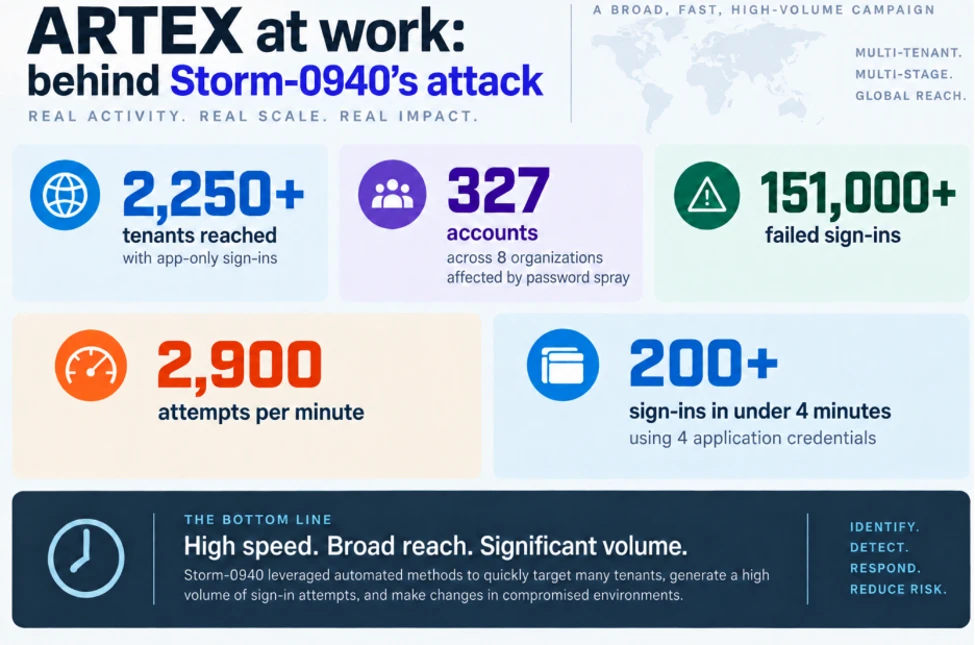
Storm-0940 Uses ARTEX AI to Compromise ConnectWise Supply Chain and Target Microsoft 365 Environments
A China‑state aligned actor, Storm‑0940, deployed the ARTEX agentic AI framework to accelerate a ConnectWise supply‑chain breach, enabling rapid credential abuse across Microsoft 365 tenants. The attack leveraged Microsoft Graph for reconnaissance and privilege escalation, exposing numerous organizations to swift, automated compromise. Defenders must review service principal activity, enforce MFA, and enable Defender XDR detections to mitigate similar threats.
Read briefing
Threat Actors Deploy Agentic AI for Autonomous Intrusion and Lateral Movement
CrowdStrike has identified four distinct threat groups leveraging agentic AI to automate reconnaissance, decision-making, and command execution. These campaigns reduce human intervention in the kill chain, accelerating intrusion timelines and complicating traditional detection methods. Defenders must update detection logic to identify autonomous behavioral patterns rather than relying solely on known signatures.
Read briefing
CrowdStrike Unveils Falcon Sensor Upgrade to Block Malicious Open‑Source Packages in Real Time
CrowdStrike has rolled out a new layer of protection inside its Falcon endpoint sensor that stops supply‑chain attacks before they hit the device. By using on‑device AI to classify and block malicious open‑source packages at download time, the update closes a key attack vector that has become a staple of modern ransomware and data‑exfiltration campaigns. The change is part of CrowdStrike’s broader push toward zero‑trust browser security and agentic SOC capabilities, giving defenders a faster, more autonomous shield against the ever‑evolving supply‑chain threat landscape.
Read briefing
CrowdStrike Unveils Agentic SOC: AI-Driven Detection and Response for Modern Threats
CrowdStrike has released the next generation of its Security Operations Center, the Agentic SOC, which leverages on‑device AI and advanced threat intelligence to automate detection, triage, and response. The update introduces Claude integration, real‑time data classification, and enhanced cloud and browser security capabilities. Defenders should evaluate the new Falcon features and enable AI‑powered workflows to reduce alert fatigue and accelerate incident handling.
Read briefing