
Threat Intel
Storm-0940 Uses ARTEX AI to Compromise ConnectWise Supply Chain and Target Microsoft 365 Environments
A China‑state aligned actor, Storm‑0940, deployed the ARTEX agentic AI framework to accelerate a ConnectWise supply‑chain breach, enabling rapid credential abuse across Microsoft 365 tenants. The attack leveraged Microsoft Graph for reconnaissance and privilege escalation, exposing numerous organizations to swift, automated compromise. Defenders must review service principal activity, enforce MFA, and enable Defender XDR detections to mitigate similar threats.
What happened
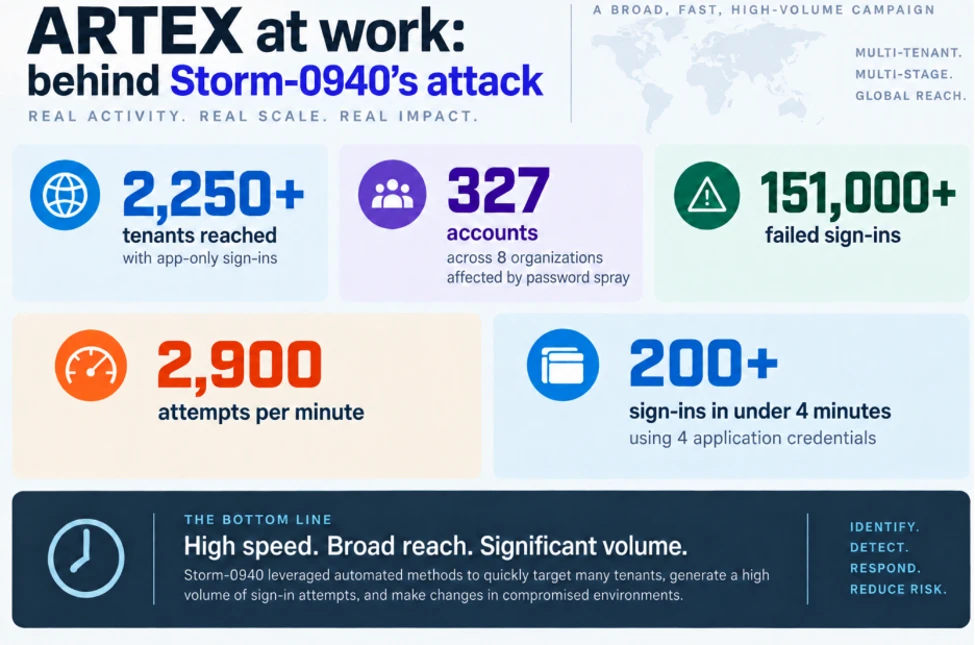
In September 2026, the threat actor Storm‑0940 leveraged the ARTEX agentic AI framework to automate penetration testing techniques against a broad portfolio of targets. The campaign focused on the ConnectWise supply‑chain, a multi‑tenant application that had already been compromised. ARTEX enabled the actor to rapidly enumerate and abuse application credentials, allowing authentication into Microsoft 365 environments without interactive user sign‑ins.
Once inside, the adversary used Microsoft Graph to conduct reconnaissance, modify application credentials, and attempt privilege escalation. The entire process—from initial targeting to privileged access—was completed in less than three hours in several instances, underscoring the speed advantage conferred by AI‑driven automation.
Who is affected
Any organization that has integrated the compromised ConnectWise application into its Microsoft 365 tenant is at risk. This includes enterprises across finance, healthcare, manufacturing, and public sector that rely on ConnectWise for remote management and service delivery.
Defenders should also consider any tenant that has granted broad application permissions to third‑party services, as the attacker could exploit those permissions to pivot within the tenant.
Impact
While Microsoft determined that the activity did not stem from a vulnerability in its own products, the compromised credentials allowed the actor to perform unauthorized actions within affected tenants. Potential impacts include data exfiltration, lateral movement, and persistence through compromised service principals.
The rapid credential abuse also increases the likelihood of undetected persistence, as the attacker can establish footholds before defenders notice anomalous activity.
Exposure
ARTEX’s AI capabilities enabled the actor to test multiple attack vectors simultaneously, reducing the time to compromise. The use of Microsoft Graph for post‑exploitation activities means that normal API usage patterns can be masked by legitimate traffic, making detection more challenging.
Because the actor did not rely on a known vulnerability, traditional patching does not mitigate this threat. Instead, exposure is tied to the breadth of permissions granted to third‑party applications and the visibility of their activity.
What to do
- Enable Microsoft Defender XDR detections for suspicious Microsoft Graph activity and known threat infrastructure.
- Review service principal sign‑ins for unexpected or anomalous activity, focusing on high‑privilege applications.
- Enforce multi‑factor authentication for all service principals and privileged accounts.
- Implement least‑privilege application permissions; remove any that are not essential.
- Rotate application credentials regularly and monitor for credential reuse across tenants.
- Deploy hunting queries that flag rapid credential changes or privilege escalation attempts via Microsoft Graph.
- Audit ConnectWise integration settings and verify that only trusted instances are active.
What to watch
Future iterations of ARTEX may incorporate more sophisticated evasion techniques, such as mimicking legitimate API call patterns or leveraging zero‑day vulnerabilities in third‑party applications. Defenders should remain vigilant for sudden spikes in API usage, especially from newly created or recently modified service principals.
Additionally, monitor for signs of automated credential abuse, such as repeated failed sign‑in attempts followed by successful authentication within a short time window. Early detection of such patterns can prevent the attacker from establishing persistence or escalating privileges.
Related articles

Storm-0940 Leverages Agentic AI to Automate ConnectWise Supply Chain Intrusion
Microsoft attributes a large-scale supply chain attack to the China-linked actor Storm-0940, which exploited compromised ConnectWise Cloud Backup credentials to target over 2,250 Microsoft 365 tenants. The group utilized an agentic AI penetration-testing framework to automate reconnaissance and privilege escalation, achieving persistent cloud access in some cases within three hours. Defenders should immediately audit third-party service credentials and review recent M365 admin activity for anomalies consistent with automated lateral movement.
Read briefing
NPM Supply Chain Compromise Detected Early via Group-IB Business Email Protection
A phishing email infected a developer, enabling attackers to compromise an NPM package before it reached the registry. Group‑IB’s Business Email Protection (BEP) intercepted the email, preventing the supply‑chain breach. Defenders should deploy BEP, monitor npm dependencies, and enforce MFA for developer accounts.
Read briefing
CrowdStrike Unveils Falcon Sensor Upgrade to Block Malicious Open‑Source Packages in Real Time
CrowdStrike has rolled out a new layer of protection inside its Falcon endpoint sensor that stops supply‑chain attacks before they hit the device. By using on‑device AI to classify and block malicious open‑source packages at download time, the update closes a key attack vector that has become a staple of modern ransomware and data‑exfiltration campaigns. The change is part of CrowdStrike’s broader push toward zero‑trust browser security and agentic SOC capabilities, giving defenders a faster, more autonomous shield against the ever‑evolving supply‑chain threat landscape.
Read briefing
UNC6671’s BlackFile Vishing Campaign Targets Microsoft 365 & Okta – Defenders’ Response
In early 2026, UNC6671 launched a vishing‑based extortion operation, leveraging adversary‑in‑the‑middle techniques to compromise SSO and bypass MFA on Microsoft 365 and Okta. The group uses Python and PowerShell scripts to exfiltrate data before demanding ransom. Defenders should monitor voice‑phishing indicators, enforce MFA, and scrutinize SSO logs for anomalous activity.
Read briefing