
Threat Intel
ClickFix Social Engineering: Defend Against User-Pasted Command Execution
CrowdStrike published guidance on ClickFix attacks, in which victims are persuaded to copy and run malicious commands in their own shells or browsers. The technique targets employees, contractors, and any user with terminal or browser access. Defenders should treat user-initiated command execution as a high-risk indicator and combine browser controls, endpoint detection, identity monitoring, and SOC triage.
What happened
CrowdStrike published a practitioner-focused briefing on ClickFix, a social engineering pattern in which attackers get users to voluntarily copy and execute malicious commands. The article describes how the technique can bypass traditional malware delivery by making the user the execution step.
It also outlines how CrowdStrike Falcon Seraphic Enterprise Browser and the broader Falcon platform can help detect and disrupt the attack across browser, endpoint, identity, and SOC layers.
Who is affected
- Employees and contractors who paste commands into terminals, shells, or developer tools.
- Users who follow support-style instructions in web pages, chat, email, or browser prompts.
- Organizations where browser, endpoint, and identity telemetry are not correlated for user-initiated execution.
Defensive implications
ClickFix is less about a single payload and more about a workflow: lure, copy, paste, execute. That makes it relevant to SecOps and sysadmins because the malicious action can look like normal user behavior if only one data source is reviewed.
Defenders should treat unexpected user-initiated command execution as a potential ClickFix indicator, especially when it follows a social-engineering lure.
What to do
- Monitor for suspicious command-line activity initiated by users, including encoded, obfuscated, or remote-download commands.
- Apply browser controls that reduce the ability to run or paste malicious content into privileged contexts.
- Use endpoint detection to identify post-execution behavior such as credential access, persistence, and lateral movement.
- Correlate identity signals, such as unusual sign-in locations, token use, or privilege escalation, with endpoint events.
- Train SOC analysts to triage user-initiated execution as a high-fidelity signal rather than routine admin work.
Related articles

CTM360 Report Highlights ClickFix as Leading Initial-Access Technique Using Malicious Copy-Paste
Recent threat intelligence from CTM360 analyzes over 17,000 URLs utilizing the ClickFix social engineering technique, which bypasses traditional security controls through manual user execution. Accounting for nearly half of Microsoft Defender Experts initial-access cases in 2025, the method relies on fake error prompts and clipboard manipulation rather than software exploits.
Read briefing
ClickFix Attacks: User-Executed Malicious Commands
ClickFix attacks rely on deceiving users into executing malicious commands, often via copy-pasted instructions. Defenders should focus on user awareness training and implement browser/endpoint security controls to prevent command execution. CrowdStrike Falcon offers layered protection against this technique.
Read briefing
ClickFix Attacks Exploit User Execution: CrowdStrike’s Defense
ClickFix leverages user‑initiated execution via malicious command prompts to compromise systems. CrowdStrike’s Falcon Seraphic Enterprise Browser and platform detect and block these vectors across browsers, endpoints, and identity services. Defenders should enable the browser extension, update Falcon, and monitor suspicious command‑line activity.
Read briefing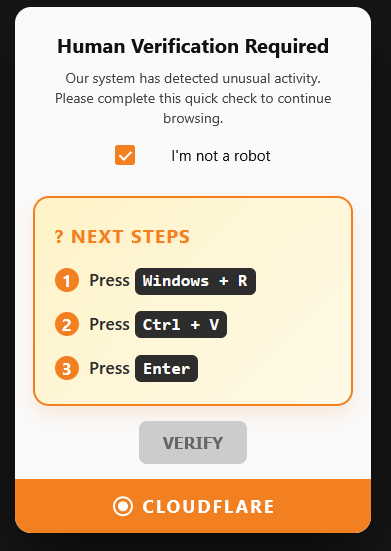
StopAndProtect: Ransomware Operation Hijacking Thousands of WordPress Sites
RootPwn’s latest intel uncovers StopAndProtect, a multi‑stage ransomware campaign that exploits compromised WordPress sites for download, command & control, and data exfiltration. The attack chain starts with a ClickFix social‑engineering lure that forces victims to run a PowerShell command, spawning .NET loaders, a SMB/USB worm, a lock‑screen module, a VBS spreader, a chat utility and a credential stealer. While not all victims receive file encryption, attackers silently harvest documents, logs and screenshots, uploading them to the same compromised sites. OPSEC lapses exposed thousands of IP
Read briefing