
Vulnerabilities
WordPress CVE-2026-87902 Exploitation: Attackers Writing Malicious Files to Disk
WordPress sites vulnerable to CVE‑2026‑87902 are now being exploited to write arbitrary files that execute shell commands. The flaw, a path‑traversal bug in get_page_template(), allows unauthenticated attackers to achieve remote code execution under specific conditions. Defenders should patch to 7.1.2 or later, verify file integrity, and monitor for suspicious file writes.

What Happened
After the WordPress 7.1.2 security patch was released, threat actors shifted from probing sites for CVE‑2026‑87902 to actively exploiting the flaw. The first malicious requests appeared at 17:44 UTC on September 22 from a handful of IPs, targeting multiple sites. The attackers now write PHP files to disk that run shell commands when accessed.
Impact
The vulnerability is a path‑traversal bug in the get_page_template() function that lets an unauthenticated user include a chosen readable .php file outside the active theme directory. If the site’s active parent or child theme contains a top‑level directory, the attacker can place a file that executes arbitrary code, giving remote code execution (RCE) with a CVSS score of 9.2.
What to Do
1. Apply the 7.1.2 patch or later immediately. 2. Verify that no unexpected PHP files exist in the root or theme directories. 3. Enable file‑integrity monitoring and alert on new files in the web root. 4. Restrict file‑write permissions for the web server user where possible. 5. Review server logs for suspicious GET requests to /wp-admin or /wp-content.
Detection Tips
Watch for HTTP requests that target wp-admin/admin-ajax.php or wp-content/themes/* with unusual query strings. Look for new files with .php extensions in the site root or theme folders that were not present before the patch. Log file creation timestamps and correlate with access logs to identify potential exploitation.
Related vulnerabilities
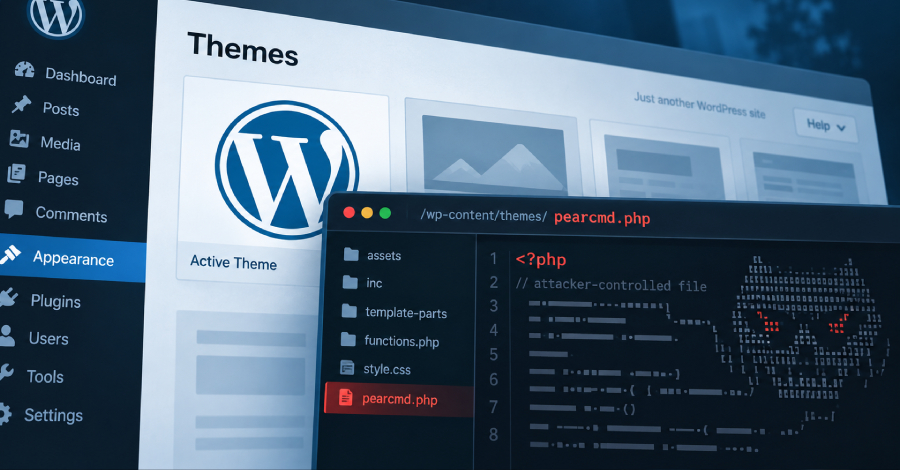
Active Exploitation of Critical WordPress RCE Vulnerability CVE-2026-87902
Threat actors are actively exploiting a critical 9.2-rated remote code execution vulnerability in WordPress, tracked as CVE-2026-87902, shortly after public disclosure. Unauthenticated attackers leverage insecure page-template resolution via get_page_template() to include local PHP files such as pearcmd.php, provided specific directory and file prerequisites are met. Defenders must audit theme configurations, apply official updates, and monitor for unauthorized file writes.
Read briefing
CISA Adds WordPress Remote File Inclusion CVE-2026-87902 to KEV Catalog
CISA has added CVE-2026-87902, a WordPress Core Remote File Inclusion flaw, to its Known Exploited Vulnerabilities catalog after confirmed active exploitation. Federal agencies must prioritize patching, and all organizations should treat the vulnerability as high risk and follow remediation guidance.
Read briefing
Critical WordPress Path Traversal Vulnerability (CVE-2026-87902) Under Active Exploitation
A critical path traversal vulnerability in WordPress, tracked as CVE-2026-87902 with a CVSS score of 9.2, is being actively exploited in the wild shortly after disclosure. Unauthenticated attackers can leverage this flaw for remote code execution under specific server and theme conditions. SecOps and sysadmins must immediately audit active themes and apply official patches.
Read briefing
Bricksforge WordPress Plugin CVE-2026-85097 Exploited: Immediate Update Required
A critical unauthenticated remote code execution flaw (CVE‑2026‑85097) in Bricksforge plugin (versions ≤3.1.8.9) has been actively exploited, allowing attackers to upload arbitrary files and take full control of WordPress sites. The issue is fixed in 3.1.8.10. Defenders must update immediately, monitor for malicious uploads, and block suspicious IPs.
Read briefing