
Vulnerabilities
Active Exploitation of Critical WordPress RCE Vulnerability CVE-2026-87902
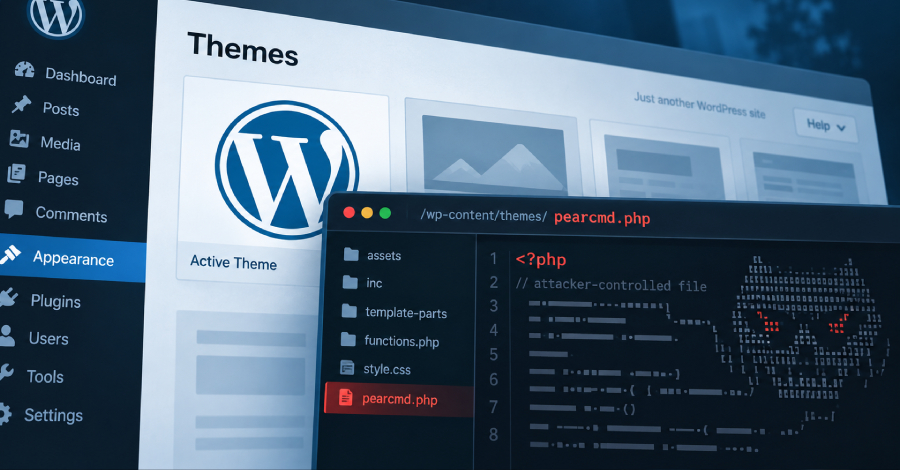
Threat actors are actively exploiting a critical 9.2-rated remote code execution vulnerability in WordPress, tracked as CVE-2026-87902, shortly after public disclosure. Unauthenticated attackers leverage insecure page-template resolution via get_page_template() to include local PHP files such as pearcmd.php, provided specific directory and file prerequisites are met. Defenders must audit theme configurations, apply official updates, and monitor for unauthorized file writes.
What Happened
Malicious actors have begun exploiting CVE-2026-87902, a critical remote code execution vulnerability affecting WordPress core with a CVSS score of 9.2. Honeypot telemetry and threat intelligence observations confirm that exploitation attempts began within hours of the advisory release. The flaw exists in the get_page_template() function, allowing unauthenticated attackers to force page-template resolution to include arbitrary local PHP files outside of active theme directories.
Exploitation Mechanics and Prerequisites
Successful exploitation requires specific environment and theme conditions to be satisfied simultaneously:
- The active parent or child theme contains a top-level directory whose name starts with "page-" (for example,
page-templates). - A target local PHP file exists on the server and is readable by the web server user account, such as
pearcmd.php.
Observed attacks involve leveraging local files like /usr/local/lib/php/pearcmd.php to write unauthorized PHP payloads or web shells into temporary directories (/tmp/) or directly onto disk.
Impact and Threat Landscape
Security telemetry has recorded numerous exploitation attempts originating from multiple IP addresses, shifting rapidly from initial reconnaissance to active payload delivery and web shell deployment. While specific environmental preconditions narrow the window of vulnerable targets, default auto-update behaviors in WordPress mitigate some long-term risk. However, legacy installations and custom themes matching the vulnerable profile remain at high risk of full system compromise.
What to Do
Sysadmins and SecOps teams should take immediate action to secure WordPress environments against CVE-2026-87902:
- Update WordPress core immediately to the latest patched version supplied by the vendor.
- Audit active parent and child themes for top-level directories beginning with "page-" that could satisfy the inclusion prerequisite.
- Inspect server environments for unnecessary or publicly accessible local PHP utility files like
pearcmd.php. - Review web server access and error logs for suspicious query parameters involving local file inclusion and unexpected file creation in temporary directories.
Related vulnerabilities

Critical WordPress Path Traversal Vulnerability (CVE-2026-87902) Under Active Exploitation
A critical path traversal vulnerability in WordPress, tracked as CVE-2026-87902 with a CVSS score of 9.2, is being actively exploited in the wild shortly after disclosure. Unauthenticated attackers can leverage this flaw for remote code execution under specific server and theme conditions. SecOps and sysadmins must immediately audit active themes and apply official patches.
Read briefing
CISA Adds WordPress Remote File Inclusion CVE-2026-87902 to KEV Catalog
CISA has added CVE-2026-87902, a WordPress Core Remote File Inclusion flaw, to its Known Exploited Vulnerabilities catalog after confirmed active exploitation. Federal agencies must prioritize patching, and all organizations should treat the vulnerability as high risk and follow remediation guidance.
Read briefing
WordPress CVE-2026-87902 Exploitation: Attackers Writing Malicious Files to Disk
WordPress sites vulnerable to CVE‑2026‑87902 are now being exploited to write arbitrary files that execute shell commands. The flaw, a path‑traversal bug in get_page_template(), allows unauthenticated attackers to achieve remote code execution under specific conditions. Defenders should patch to 7.1.2 or later, verify file integrity, and monitor for suspicious file writes.
Read briefing
Citrix NetScaler RCE Vulnerability (CVE‑2026‑107406) Requires Immediate Patch
Citrix has disclosed a critical memory‑overflow flaw in NetScaler ADC and Gateway appliances that can be leveraged for remote code execution or denial‑of‑service when configured as a SAML IdP or SP. Affected systems must be upgraded to the latest patched releases without delay. No active exploits reported yet, but defenders should verify patch status and monitor traffic.
Read briefing