
Vulnerabilities
Critical WordPress Path Traversal Vulnerability (CVE-2026-87902) Under Active Exploitation
A critical path traversal vulnerability in WordPress, tracked as CVE-2026-87902 with a CVSS score of 9.2, is being actively exploited in the wild shortly after disclosure. Unauthenticated attackers can leverage this flaw for remote code execution under specific server and theme conditions. SecOps and sysadmins must immediately audit active themes and apply official patches.

What Happened
A critical security defect affecting WordPress page-template resolution, designated as CVE-2026-87902, has come under active exploitation within hours of public disclosure. Carrying a CVSS score of 9.2, the vulnerability is a path traversal flaw that impacts unauthenticated remote attackers under specific environmental preconditions.
Impact & Mechanics
The flaw stems from how the get_page_template() function resolves page templates, potentially permitting the inclusion of local PHP files located outside designated active theme directories. Successful exploitation requires specific environmental parameters:
- The top-level directory name of the active parent or child theme must begin with
page-. - The web server process account must possess read access to a target local PHP file on the host.
- Attackers have reportedly combined this flaw with techniques such as the pearcmd.php PEAR-to-RCE vector when PHP's
register_argc_argvdirective is enabled.
"An unauthenticated attacker can make get_page_template() page-template resolution include a chosen readable local .php file outside the active theme directories." — WordPress Security Advisory
What to Do
Defenders and system administrators managing WordPress deployments should act promptly to mitigate risk:
- Apply official vendor patches or updates immediately as released by WordPress.
- Review active theme directory naming conventions to ensure top-level folders do not start with
page-. - Verify PHP configuration directives on the server, specifically ensuring
register_argc_argvis disabled where possible. - Monitor web server access and error logs for suspicious path traversal attempts or unauthorized inclusion of local files.
Related vulnerabilities

WordPress CVE-2026-87902 Exploitation: Attackers Writing Malicious Files to Disk
WordPress sites vulnerable to CVE‑2026‑87902 are now being exploited to write arbitrary files that execute shell commands. The flaw, a path‑traversal bug in get_page_template(), allows unauthenticated attackers to achieve remote code execution under specific conditions. Defenders should patch to 7.1.2 or later, verify file integrity, and monitor for suspicious file writes.
Read briefing
CISA Adds WordPress Remote File Inclusion CVE-2026-87902 to KEV Catalog
CISA has added CVE-2026-87902, a WordPress Core Remote File Inclusion flaw, to its Known Exploited Vulnerabilities catalog after confirmed active exploitation. Federal agencies must prioritize patching, and all organizations should treat the vulnerability as high risk and follow remediation guidance.
Read briefing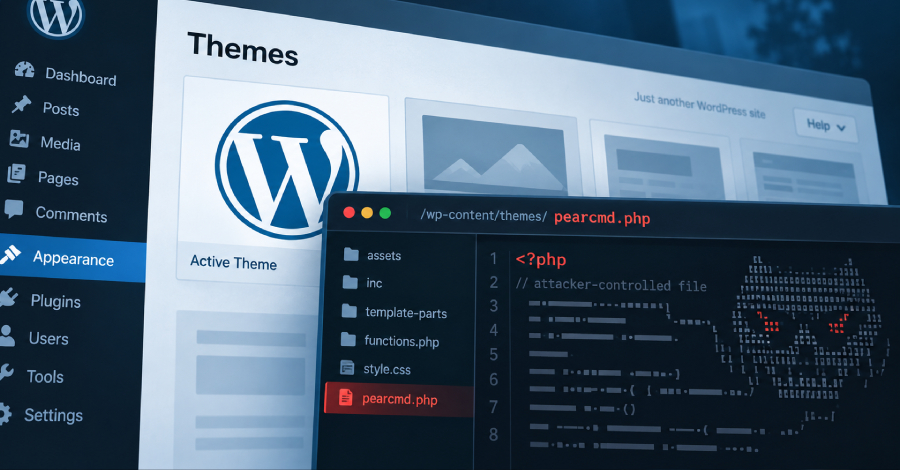
Active Exploitation of Critical WordPress RCE Vulnerability CVE-2026-87902
Threat actors are actively exploiting a critical 9.2-rated remote code execution vulnerability in WordPress, tracked as CVE-2026-87902, shortly after public disclosure. Unauthenticated attackers leverage insecure page-template resolution via get_page_template() to include local PHP files such as pearcmd.php, provided specific directory and file prerequisites are met. Defenders must audit theme configurations, apply official updates, and monitor for unauthorized file writes.
Read briefing
CISA Expands KEV Catalog with GitLab Path Traversal CVE-2026-85706
CISA has added CVE-2026-85706, a path‑traversal flaw in GitLab Community and Enterprise Editions, to its Known Exploited Vulnerabilities catalog after confirmed active exploitation. The move reinforces the agency’s push for rapid patching of high‑risk bugs under BOD 26‑04 and serves as a reminder for all organizations to prioritize KEV fixes.
Read briefing