
Threat Intel
BTR Reforged: Turning a Signed Windows Defender Driver into a Kernel‑Level Attack Engine
Checkpoint Research has shown that Microsoft’s own BTR.sys – the Boot‑Time Removal driver used by Windows Defender – can be hijacked to perform arbitrary file and registry operations from Ring 0. By reverse‑engineering the driver’s encrypted transaction format and building a tool called BTR_CLI, researchers demonstrated a kernel‑mode operation primitive that bypasses EDR/AV without exploiting a vulnerability. The study exposes how trusted signed components can become powerful attack tools, urging defenders to scrutinize remediation drivers and implement stricter driver‑loading controls.
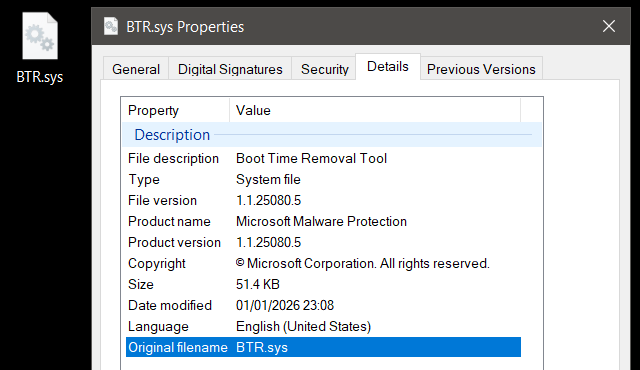
During a routine incident‑response investigation, a seemingly innocuous Windows Defender driver named BTR.sys appeared on disk with a random filename and a transient service entry. At first glance, the driver’s behavior resembled a classic kernel‑level loader: it dropped a driver just before reboot, used an alternate data stream (ADS) to store an encrypted configuration, and cleaned itself up after execution.
What is BTR.sys?
BTR.sys is the Boot‑Time Removal tool that Microsoft ships to wipe malware from the system before Windows fully boots. The driver is signed, system‑trusted, and normally only performs a narrow set of remediation tasks.
How the Attack Works
- Researchers reverse‑engineered the driver’s transaction protocol and discovered that it accepts an encrypted payload that dictates file and registry actions.
- Using a custom tool, BTR_CLI, they crafted valid encrypted transactions, loaded the driver via a temporary service, and triggered the driver to execute arbitrary commands from kernel mode.
- Because the driver is signed and trusted, the operation bypasses most EDR and AV checks that rely on signed‑driver enforcement.
- No memory corruption or exploitation is required; the driver itself becomes the attacker‑controlled primitive.
Implications for Defenders
This work illustrates how a legitimate, signed security component can unintentionally expose a powerful kernel‑level capability. The findings suggest that:
- Signed remediation drivers should be treated as high‑risk primitives and monitored for unusual configuration changes.
- Systems should enforce stricter controls on driver loading, such as mandatory code‑signing checks and runtime integrity verification.
- Detection engines need to flag the creation of transient services that load signed drivers with ADS‑based configurations.
Mitigation Recommendations
1. Disable or harden the BTR.sys driver on systems that do not require boot‑time malware removal. 2. Implement driver‑loading whitelists and monitor for temporary service registrations. 3. Deploy runtime integrity monitoring to detect unexpected encrypted payloads in driver ADS streams. 4. Keep EDR/AV solutions updated to recognize BTR_CLI‑style activity as suspicious.
Checkpoint’s research underscores that defensive tools can become offensive assets when their internal logic is exposed. Continuous scrutiny of signed components and robust driver‑loading policies are essential to prevent such weaponization.
Related vulnerabilities

Linux Kernel NTFS3 Out‑Of‑Bounds Read Vulnerability (ZDI‑26‑697) – Patch Required
A local attacker with low‑privilege code execution can read beyond array bounds in the NTFS3 driver, exposing sensitive data and potentially enabling kernel‑level code execution. Linux kernel maintainers have released a patch; administrators should update immediately and monitor for exploitation attempts.
Read briefing
Fake LastPass Installers Deploy Kernel-Driver EDR Killer and Rapuncel Infostealer
A campaign using counterfeit LastPass Authenticator apps has pushed a Microsoft‑attested kernel driver that disables 145 security products and installs the Rapuncel infostealer. The attack leveraged GitHub and Cloudflare to distribute the malicious payload, impersonating at least 40 organizations. Defenders should block the malicious driver, verify kernel modules, and update EDR signatures.
Read briefing
CrowdStrike’s SafeMind: Turning Offense Into the Ultimate Defense
CrowdStrike’s SafeMind platform turns the traditional offense‑defense dichotomy on its head by creating a closed‑loop system where simulated attacks continuously feed back into the detection engine. By feeding real‑world attack vectors, threat hunters, and AI models into the same pipeline that protects the enterprise, SafeMind sharpens its defenses against the most sophisticated adversaries. The initiative has earned CrowdStrike a top spot in the Forrester Wave for External Threat Intelligence Service Providers (Q3 2026), underscoring its effectiveness in turning proactive hunting into reactiv
Read briefing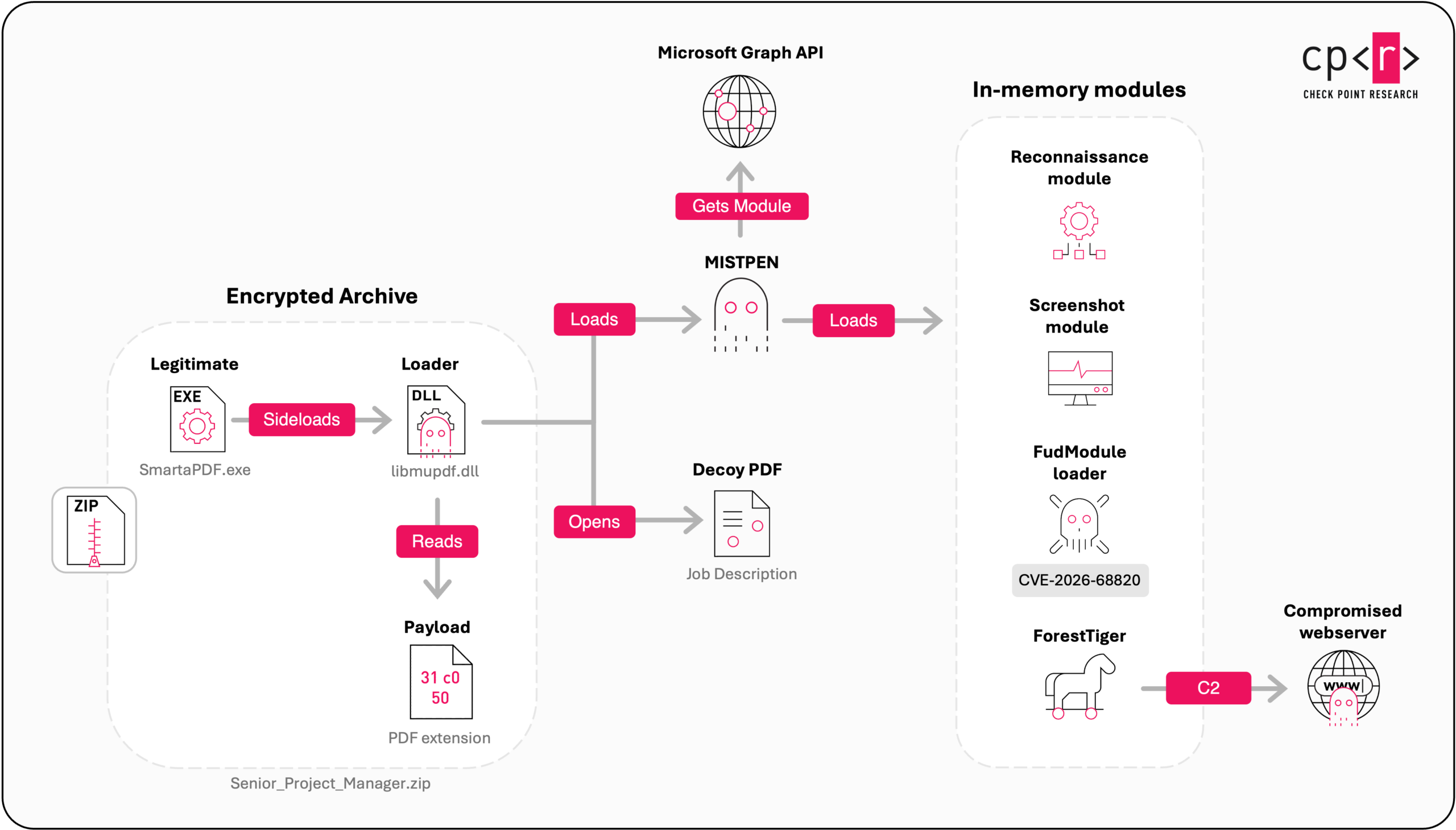
Operation Dream Job: From Job Offers to Zero‑Day Attacks on Defense Sectors
Check Point Research has traced a fresh wave of the Operation Dream Job campaign, a Lazarus‑linked effort that turns enticing job ads into a multi‑stage breach. The attackers now use a trojanized PDF viewer, the SecurityPDF app, to deliver a new kernel‑mode rootkit (FudModule) via the zero‑day CVE‑2026‑68820 in Microsoft’s AFD.sys driver. They also weaponize CVE‑2025‑49113 in Roundcube to plant RelayShell webshells, turning compromised servers into covert C2 relays. The campaign targets aerospace, aviation and defense firms worldwide, leveraging spear‑phishing, SEO‑boosted fake recruitment sit
Read briefing