
Vulnerabilities
Ivanti Connect Secure Zero‑Day Exploited in the Wild (CVE‑2026‑104935)
A high‑severity authentication bypass in Ivanti Connect Secure allowed unauthenticated attackers to execute arbitrary commands. The flaw was already exploited before disclosure, prompting CISA to add it to the KEV catalog. Defenders must patch immediately and harden VPN access.

What happened
On 13 Oct 2026, Ivanti disclosed CVE‑2026‑104935, a high‑severity authentication bypass in Connect Secure (ICS) that allows unauthenticated remote attackers to run arbitrary commands. The flaw, a spoofing vulnerability (CWE‑290), was already being exploited in the wild before the advisory was issued.
Impact
Exploit activity was confirmed by CISA and documented by the forensics firm Volexity. Affected customers run any supported version of Ivanti Connect Secure that had not yet received the July 2026 patch (25.1.3.0). The vulnerability can be leveraged to gain full system control, and threat actors also used an unpatched privilege‑escalation flaw to widen their foothold.
What defenders should do
- Verify whether your environment runs a vulnerable version of Connect Secure. If so, apply the July 2026 patch or later immediately.
- Block inbound traffic to the VPN appliance on the default port (TCP 443) unless it is required for business use, and enforce strict authentication.
- Deploy network segmentation and monitoring to detect anomalous command execution or lateral movement from the VPN.
- Review logs for signs of spoofed authentication attempts or unexpected remote command execution.
- Consider disabling legacy authentication methods that may be exploited by the bypass.
Future mitigations
Ivanti plans to address a related privilege‑escalation issue in a subsequent release. Until then, maintain the latest patch level and keep the VPN appliance isolated from critical assets.
Related vulnerabilities

Ivanti Connect Secure Zero‑Day Exploited: Immediate Patch Required
An actively exploited authentication‑bypass zero‑day (CVE‑2026‑104935) has been found in Ivanti Connect Secure. The flaw affects versions 22.8R2.4 and earlier, 25.1.2.2 and earlier, and 25.1.1.1 and earlier, allowing unauthenticated remote attackers to run arbitrary commands. Defenders must patch immediately and run the Integrity Checker Tool.
Read briefing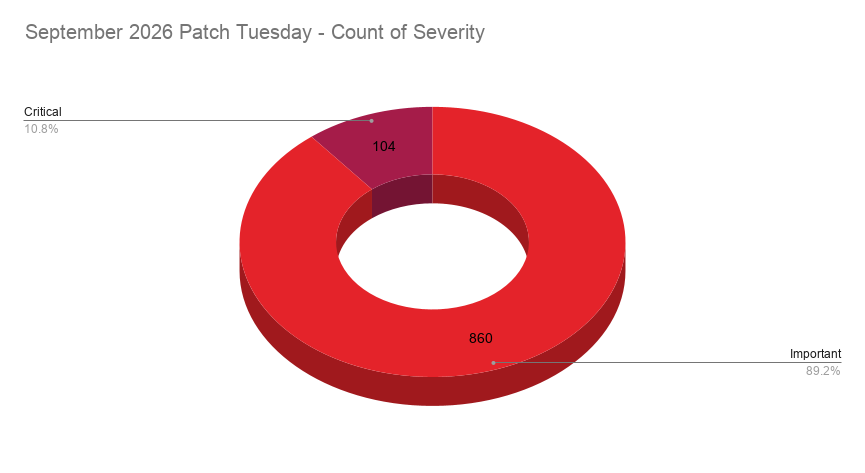
Microsoft September 2026 Patch Tuesday: 964 CVEs, Including Two Zero-Day Exploits (CVE-2026-81963, CVE-2026-85880)
Microsoft released its largest Patch Tuesday to date, addressing 964 CVEs—104 critical and 860 important—including two zero‑day vulnerabilities exploited in the wild. Defenders must prioritize applying updates to affected components such as .NET, Active Directory services, Azure services, Office, and Windows kernel drivers, and verify system integrity.
Read briefing
SAP Exposes Critical Kernel & Message Server Flaws: CVE-2026-44756 & CVE-2026-58240
SAP’s September Security Patch Day revealed two critical vulnerabilities that can be exploited remotely without authentication. The memory‑corruption flaw in SAP Extended Passport (OVERPASS, CVE‑2026‑44756) and the missing‑auth bug in NetWeaver Message Server (S4GET, CVE‑2026‑58240) both allow attackers to run arbitrary OS commands as the SAP installation user, risking full system takeover. Immediate application of SAP Security Notes 3747649 and 3759472 is mandatory.
Read briefing
Cisco Secure Email Gateway CVE-2026-76461 Zero-Day Exploited in the Wild
Cisco has patched a critical SQL injection vulnerability, tracked as CVE-2026-76461, in the AsyncOS software used by Cisco Secure Email Gateway. The flaw allows unauthenticated, remote attackers to achieve root-level command execution via crafted emails and is actively exploited in the wild. SecOps and sysadmins must immediately apply the vendor-supplied firmware updates.
Read briefing